

I watched someone sing tonight on an AGT video. It was astounding. Amazing. And as soon as I said to myself, “that was amazing” I heard my father’s voice: “And it wasn’t even on a sandwich!”
My dad used to say that just about any time he heard the word “amazing.”
I often say it myself these days, although I usually say “sammich.”
I don’t know why. I just do.
But I always hear it in my dad’s voice.
I miss him. My dad, that is; not the guy from the AGT video. Despite our complicated lives — together and apart — he’s been an integral part of who I became. Of who I am. I’ve written about him often. One of my favorite pieces is still unfinished. I won’t get into it here, but I will quote this portion of it:
When I was little, my father was a large man. He was strong and brown with dark eyes and darker hair, stiff and wavy and thick. Not once in all the twenty-six years I knew him did one of those hairs move. Each had its own special place, its own course to trace along the contours of his head. I imagined that, at night, those hairs fought and jostled one another as the pillow pushed them first to the left and then to the right. In the morning they all quickly forgot their arguing and snapped crisply back into position.
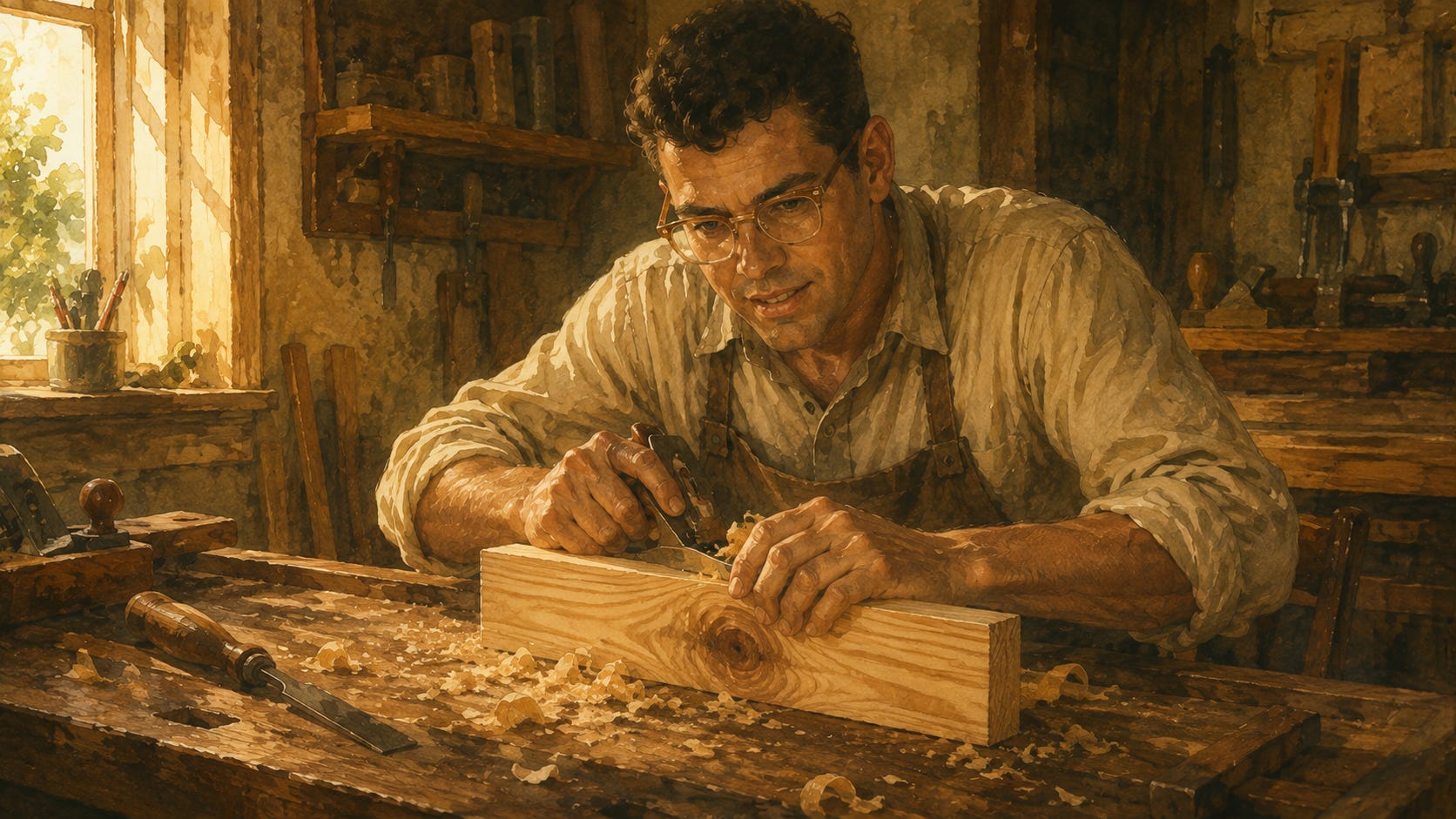
At night, when he came home from work, he liked to work in his shop. Sometimes I would stand in the front yard, where I could watch without him knowing from the shadows. He was lost for long periods on the details of the corners of the furniture he was building, the wood he was shaping against its will into something useful, something functional, something of which he could be proud. His head was bent low over the bench; his eyes riding above his fingernails as he carefully filed a recalcitrant knot in the pine. Concentrated on his concentrated features, I wondered what he was thinking and what it would be like to be him.
There was a pained tension between he and I, agonal in nature, the ache of two who love each other but don’t know how, and are afraid to admit it, as if caring for one another was an inherently shameful feeling. I knew he loved me because he worked on me with the same careful concentration he gave to woodworking. He used to try and tell me how important it was to select just the right tool for working the wood, the importance of understanding the lie of the grain and of not working against it. I believe I was the most enigmatic piece he ever tried to work, and the only one he worked without reward. Bilateral love, bilateral inscrutibility. He never found the right tool to smooth out my knots. Not that he didn’t try.
— Rick Horowitz, portion of an unfinished draft I won’t name here yet
I’ve left the last line off this section. It gets into something I’m not really ready to talk about yet. About who I was at the time. And how it shaped who I’ve become.
Connie Chang writes about something linguists call familect, or familylect.
The secret words and phrases shared exclusively among the members of a household are what linguists call familect (sometimes called familylect). And though it might just sound like a family being silly, building a familect can have emotional benefits for kids and adults.
— Connie Chang, Why your family’s secret language is good for kids (October 18, 2021)
Familects include words, expressions, nicknames, anecdotes — the in-jokes that make each family amazing, even if the family isn’t fond of sandwiches. They come from a shared history and evolve to establish a family’s identity.
And the identities of the individuals they grow.
According to the Psychoanalysis Wiki, Freud — not much in vogue these days, so far as I understand it — developed the idea of introjection in his understanding of the formation of the superego. For him, it was a necessary part of normal moral development.
As the Wiki points out, that concept, extended, points to how “cultural and social values become internalized.” This is where the familect slots in. It creates, at the closest and most intimate level, the milieu we draw from in coalescing into competent — or sometimes incompetent — persons; it produces personality.
Now, I’m no professional linguist or psychologist, though I have stayed at a Holiday Inn Express once or twice in my life. So someone might say I’m stretching the familect idea a bit. But I don’t think so. “Sandwich” — and my morphing it into “sammich” — seems to me to be both an obvious mechanism and a demonstration of introjection. The less-obvious parts and patterns of speech are part of the familect, as well.
“You’re stupid!” Or “don’t be so stupid.” Or “that wasn’t very smart” may not be traditional neologisms, but they are equal partners in the family vernacular — the verbal imprints that work to shape a person. They’re less-consciously internalized in the same way, through repeated exposure.
When I was a young bulb in the familial garden, one of my dad’s favorite phrases was “you’re very smart, but you’ve got no common sense.” I internalized that belief. Claimed it as my own for much of my life.
The way I internalized it was a problem. Just as I transformed “sandwich” into “sammich,” I also transformed “you’re very smart, but you’ve got no common sense” into something that made actual sense to me: my dad’s trying to soften the blow of calling me stupid by prefacing it with “you’re very smart.”
It’s not true. Well, maybe I’m smart. But like a lot of people, I sometimes do dumb things. And I’ve done a lot of amazing things in my life that go far beyond two slices of bread. (Full disclosure: I’ve also learned to bake a mean sourdough and even built myself a proofer.)
The point here is not to toot my own horn. I can talk about all the stuff I’ve done some other time. The point here is that we’re all born into families and those families will have a say — by what they say, as well as by what they do — in who we become.
There is a proverb often attributed to the Lakota:
We will be known forever by the tracks we leave.
The Tanakh, or “Old Testament” as it is known to some, says that God visits the sins of the fathers unto the third and fourth generations. Most biblical citations of this concept carry the idea of punishment. If true, this seems to me inherently unfair. In essence, this has God punishing the wrong people. Or, worse, it presents God as a vindictive entity who just doesn’t know when to quit.
But I’ve never really read it either as sin or punishment and not just because I don’t believe in gods. Well, hmmm…maybe that is the reason I don’t read it that way. How I read it is that most of us are part of families. Those families and the individuals within them create an environment which a moment ago I called a familial garden in which our young grow.
The familect, among other things, functions as the fertilizer in that garden. And just as young plants take up nitrogen, phosphorus, and potassium from the fertilizer they’re fed, so do children introject from the familect, attitudes, and behaviors of the familial garden. As one might expect, the more powerful the person who serves as their model, the more impact they will have.
It is in this sense that the sins of the fathers — and every other family member — are visited unto the third and fourth generations. Each “sin” has an impact; repetitive “sins” become candidate introjects.
I watched Jourdan Blue sing Breakeven again just now — that’s the AGT clip that got me writing and it seems appropriate that it brings us to the close — and at the very end, you can see Simon Cowell mouth, “Wow!” I was again, feeling a little of the wet eye, and right after the “Wow!” it came again. “Amazing.”
And it’s not even on a sammich.
I enjoyed this essay. Indeed, these familects are passed on to the next generation. They become part of our own syntax for sure. Thanks for sharing such a personal note.
I love the way you write.