

You might recall me mentioning in my first post — my inaugural post here at Coffee and a Corndog — that I’m old.
How old am I? Well, we’ve already established that I’m older than the Internet. But this little story is going to knock me back a couple more decades from that.
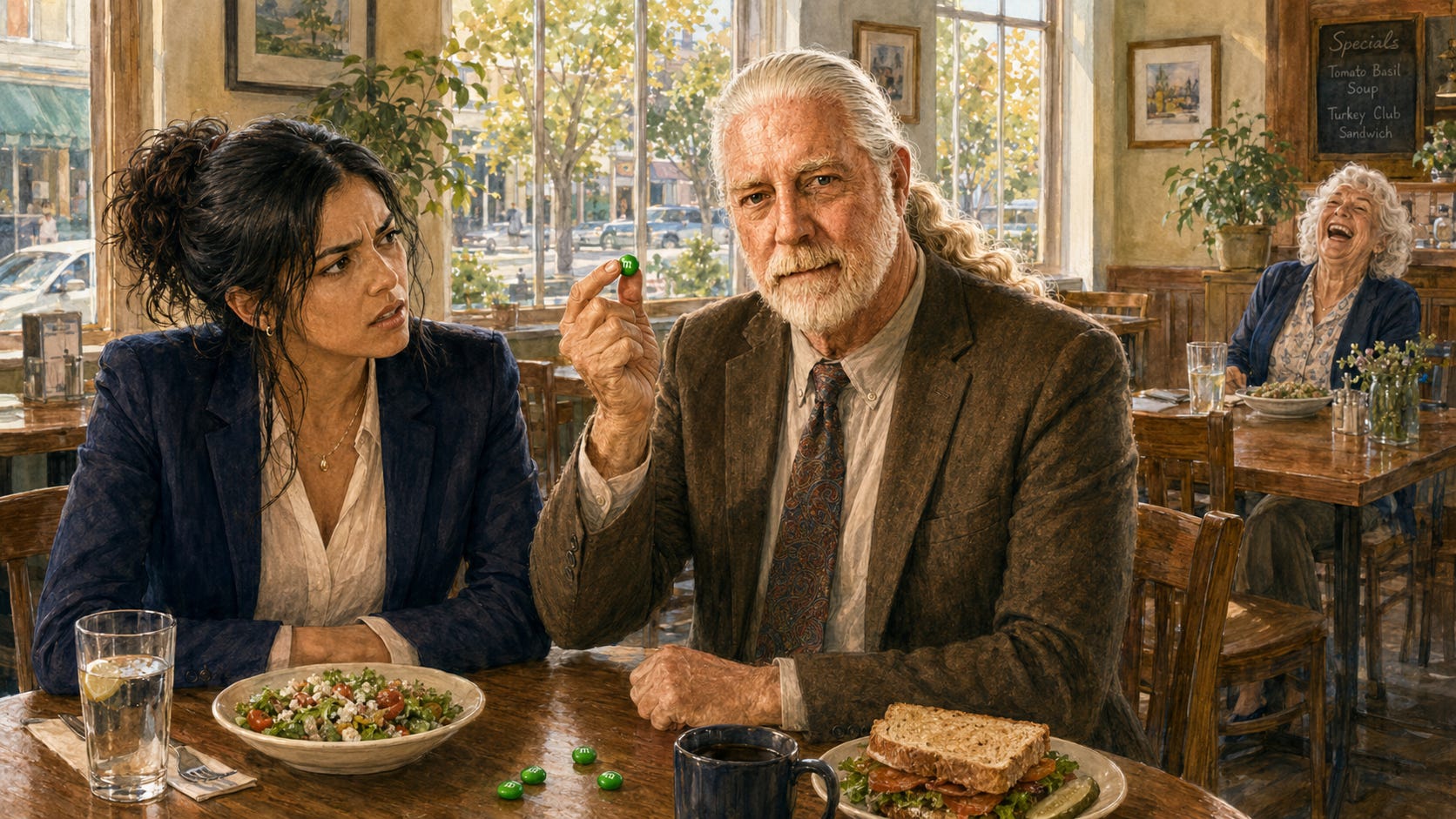
I was having a conversation with a young Latina lawyer-friend. And somehow we got on the topic of M&Ms. I don’t remember exactly why. But I mentioned that lately I’ve been giving all the green ones to my wife and I’ve been surprised at how many M&Ms that comes to out of a bag.
“Why the green ones?,” she asked.
An older woman — well, probably my age, so I don’t know why I’m saying “older” — nearby burst into laughter. I just stared at my friend.
“I don’t know. I mean, they don’t really work anyway, do they?”
“Work at what?,” she asked. The background laughter seemed to grow.
And then it hit me. My friend was in her 20s. I just turned 68 a couple days ago. The laughter, as I already said, came from someone who looked to be part of my same cohort.
“You really don’t know about green M&Ms?,” I asked.
There was a shout from behind us — “THEY MAKE YOU HORNY!” — followed by more uproarious laughter.
My Latina friend blinked. She looked very much like Bambi after just wandering out onto a freeway at night.
So I started to give her a little history lesson on the 1970s. “You see, back when I was in high school….”
But there’s really a more interesting history to the story.
Forrest Mars, Sr., had come up with the idea for his hard-shelled candy coating small pieces of chocolate back in the 1930s after seeing soldiers in Europe eating British-made “Smarties.” The sugar shell on the Smarties kept the chocolate from melting all over the soldiers fingers while they were in the battlefield.
M&Ms came into being sometime around 1941. That’s when Forrest Mars and Bruce Murrie, the two Ms, teamed up to start “M&M Limited.” Mars had the idea for the candies. But he needed a reliable source of chocolate during the war-time shortage (During World War II, chocolate was strictly rationed). Murrie was the son of William Murrie, the president of Hershey Chocolate. Mars also had the idea — because of the rationing — of targeting the U.S. military as their first customer. In fact, it wasn’t until after the war that M&Ms became available to the general public.
I remember the marketing slogans when I was young, which directly tie to the reason the military liked the candies so much: Melts in your mouth! Not in your hands!
But back to our more colorful story.
A lot of people don’t know this, but the colorful shells on M&Ms have been there since the start. I used to hear that the original M&Ms were only brown. But that’s not true. The original colors included brown, yellow, green, red, and violet.
It was the peanut M&Ms, which came along in 1954, that were originally only available in a tan color. The color was supposed to look the color of a peanut shell. As you probably know, they eventually became available in colors, also.
(Interesting side note: the red color was banished briefly in the 1976 over the red dye cancer scare. This was purely a reaction to public fear, because red M&Ms did not actually use the FD&C Red No. 2 that was the source of the scare. It was returned around 1987 by popular demand after a Tennessee college student launched a “Save the red M&M!” campaign.
Another piece of irony: the Red Scare was caused by Russian scientists!
Bambi — not her real name — recovered enough to ask, “Why did high school students think green M&Ms made people horny?”
So I explained. First, though, we should probably remember that high school students pretty much get horny over anything. They don’t really need green M&Ms. And the rumor actually started in the early 1970s on university campuses. There’s a whole article in Contemporary Legend series 3, vol. 2 (2012), “Chocolate as an Aphrodisiac: Are Green M&Ms Randy Candy?”, if you’re interested. It’s where I got a lot of my information for this essay.
But I remember how giddy we got over green when I was still in high school. It didn’t take long before our parents were reacting as Bambi had over our covert “Green Ones” jokes.
Interestingly, this whole thing about chocolate candies causing coital considerations really goes back centuries. And, again, a great source for this information is the “Randy Candy” article I linked above.
Hernan Cortes shipped cacao from the Yucatan to Spain in 1585. Francisco Hernandez published “General History of the Things of New Spain” [sic] in 1556, and asserted that cacao excited venereal appetites.
— Robert MacGregor, Chocolate as an Aphrodisiac: Are Green M&M's Randy Candy?, 2 Contemp. Legend 44, 44 (2012)
MacGregor appears to have conflated two books here — the General History of the Things of New Spain is Sahagún’s, and Hernández wrote the Natural History of New Spain, which wasn’t published until long after he died. Cortés, for his part, had been dead since 1547.
Anywayser, this is believed to be the earliest writing by a European on the subject of hornification by chocolate. It was followed by others, including a friend of Thomas Hobbes, the Marquis de Sade, Casanova (who used chocolate to seduce his more difficult “targets”), to name just a few.
If you want more on that,
James Runcie provides another romanticized history of chocolate as an aphrodisiac in The Discovery of Chocolate. (2001). His main character, Diego de Goday, is given the elixir of life in a chocolate drink. A young Spanish conquistador with Cortes, he lives from the early 16th century to the present. From 1518 he travels through time and space and meets iconical, important figures in the history of chocolate: Sacher of Vienna, Fry of England, Hershey of America, and Marquis de Sade. Throughout the novel he is consumed with a passion to perfect the taste and influence of chocolate. He understands chocolate to be a magical substance and witnesses all the human passions and the obsessions chocolate has inspired from its earliest days.
— Robert MacGregor, Chocolate as an Aphrodisiac: Are Green M&M's Randy Candy?, 2 Contemp. Legend 44, 45 (2012)
Green, by the way, was also often associated with women, fertility, sensuality…. Emeralds were supposed to have the ability to speed up childbirth.
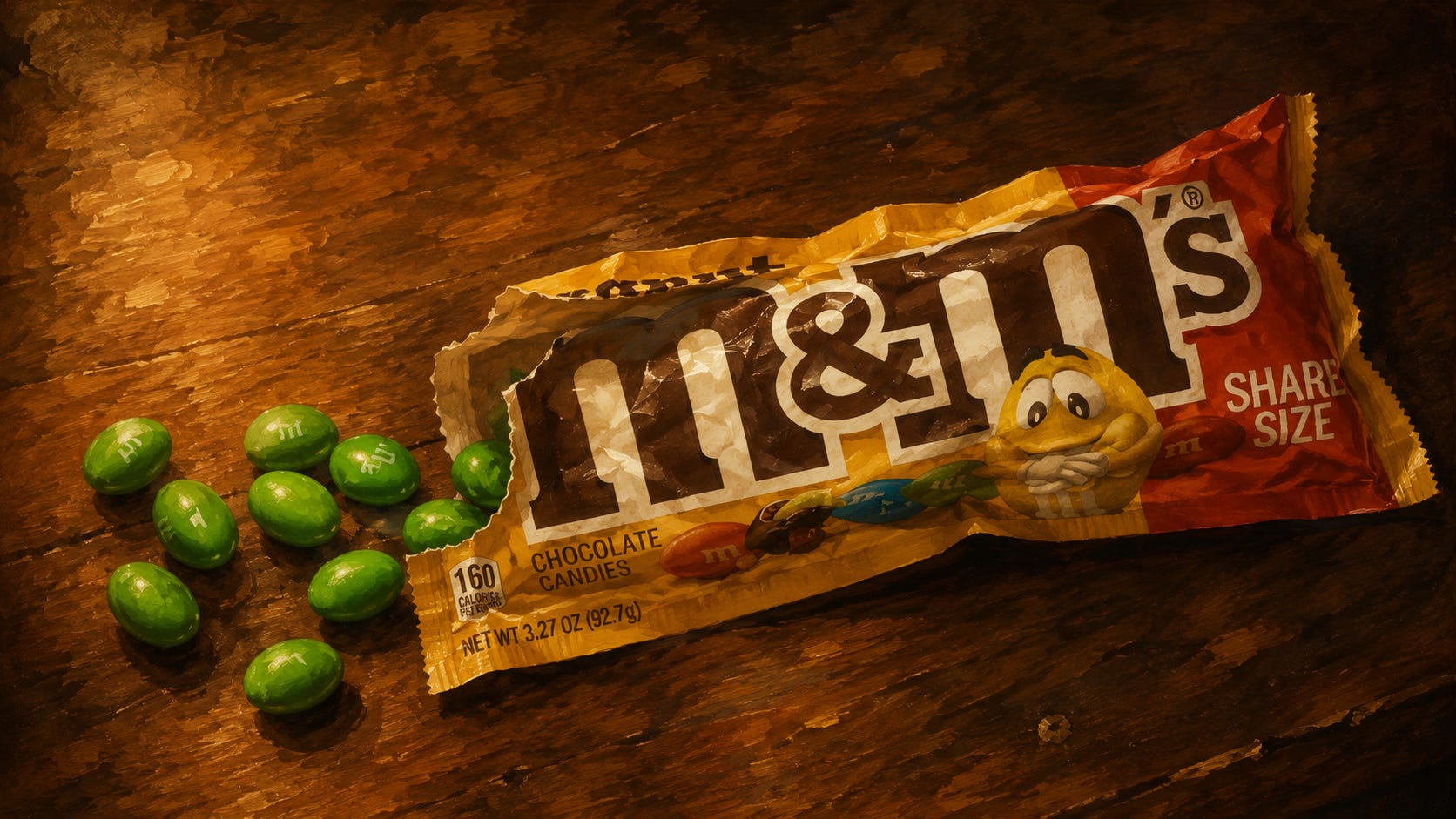
In the 1990s, Wendy Jaffe decided to capitalize on this whole mythos. She started a company called “Cool Chocolate Inc.” which had only one product: “Green Ones.” It was basically a green M&M — well, except that it was disc-shaped — and she even admitted that green M&Ms were the inspiration.
Mars (the corporation) sued her and shut her down.
Here’s where I think things get a little interesting. Later on, in January 1997, Mars leans into the whole thing, launching a commercial where Dennis Miller (the comedian) interviews the first female M&M character, “GREEN”. She was pouty-lipped, very feminine, and had long lush eyelashes.
Miller asks her, “Is it true what they say about green M&Ms?”
“What have you heard?!” exclaimed the green candy, shocked and defensive.
— Robert MacGregor, Chocolate as an Aphrodisiac: Are Green M&M's Randy Candy?, 2 Contemp. Legend 44, 49 (2012)
So Mars shut down Jaffe for selling the legend. Then Mars itself went on television and sold the myth.
That’s why, I think, Bambi never heard of it. Rumors stay alive because somebody has to tell it to you. But once Mars was telling it — on national TV, with eyelashes — nobody else needed to pass the rumor anymore. The campaign eventually ran out of gas and there was nothing left underneath it. My friend grew up with a green M&M whose entire personality was the punchline of a joke no one had ever told her.
Except that afternoon somebody did. A stranger shouted it across a room at a volume you could hear all the way back to the 1970s. Which is a little different from how I learned it, in whispers and giggles in a high school hallway from an old girlfriend, sometime around 1975.
So: how old am I? Old enough to have gotten green the right way.
I also remember green being the aphrodisiac color when I was in high school during the 80s.
I enjoyed learning the history of the chocolates.
I have a jar of green M&Ms on my desk. Any guesses where I got them???