


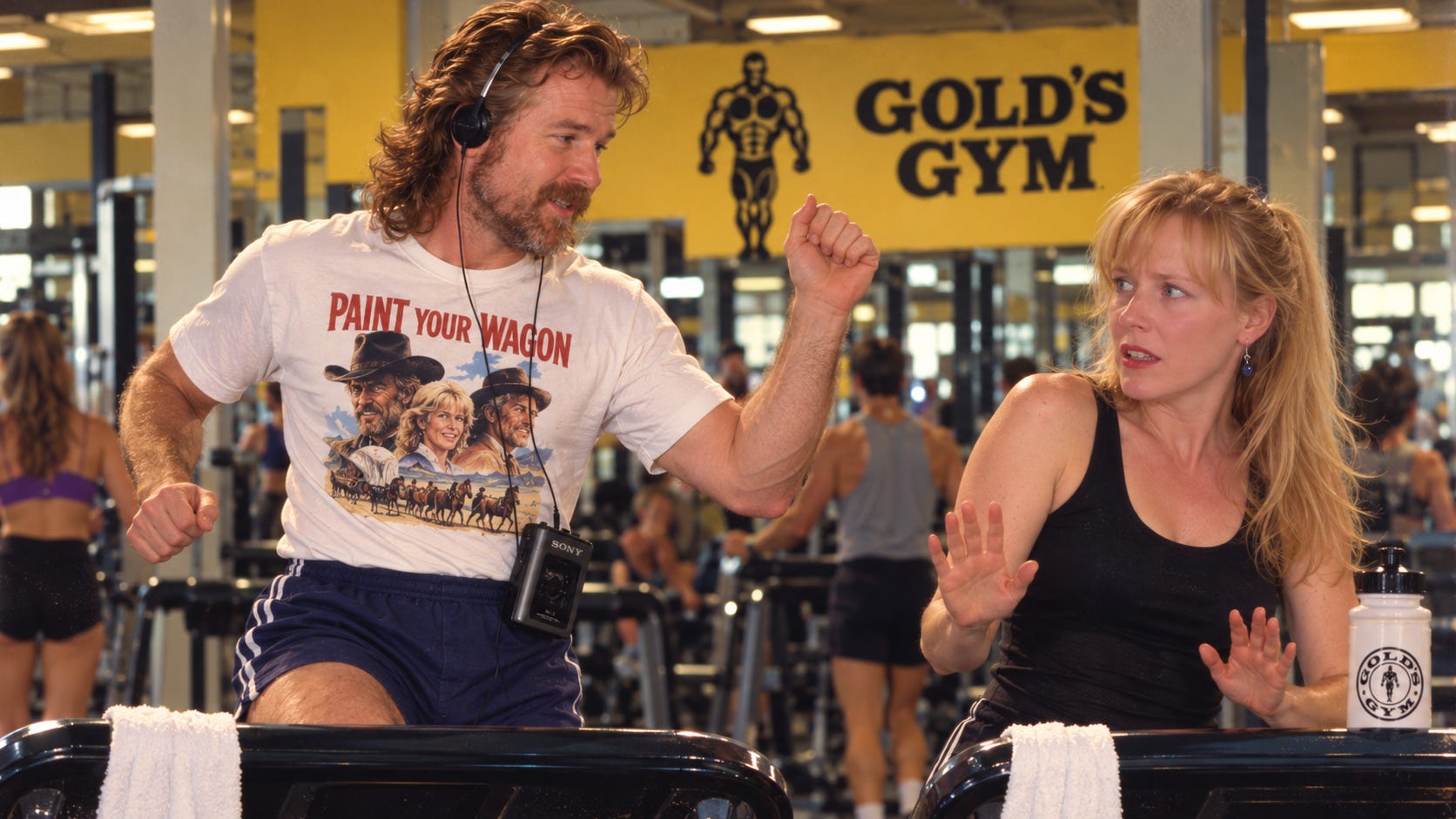
Back when Bunny Chafowitz and I first met, I was acting and singing in musicals at Roger Rocka’s Dinner Theater here in Fresno. (I also did a play or two at Second Space.) At the time of the story I’m about to tell you, I was mining for gold in a production of Paint Your Wagon at Roger’s.
Bunny and I were exercising on treadmills at Gold’s Gym near my apartment. And I had an old Walkman cassette player — how far technology has come — and was listening to one of the dance numbers while on the treadmill next to Bunny. I started dancing a little jig on the treadmill to the music and singing my part, quietly, to myself (Bunny begs to differ).
Bunny said, “Stop!” and she looked suddenly horrified. Her voice was the sort of urgent yet hushed warning you might use in a theater if your kids were talking. I said something about “just rehearsing” or “having fun” or some other thing, but I did not stop.
Suddenly, Bunny became more urgent. “Stop! Stop! Everybody’s looking!”
I looked around. Nobody was looking that I could see. But as she had stopped her treadmill and become increasingly upset and started crying, I stopped my treadmill and turned toward her.
“What’s going on?” I asked. “What’s happening?” I explained that this was not a normal response to me dancing a jig on the treadmill and I was concerned. She was, by then, crying uncontrollably.
She proceeded to tell me the story of her ex and how abusive he was. I knew a little because there had already been problems with him threatening to come to her job and “make a scene.” And apparently “making scenes” was a control move of his. He would blow up or throw something and curse or do some other thing that would cause Bunny to feel humiliated.
She told me all this in fits and starts between jags of being unable to breathe due to the crying. (And she’s asthmatic.)
I put a hand, gently, on each shoulder. “I want you to do something for me, okay? Can you do something?”
She just looked at me with her pained expression, through tearful eyes.
“Repeat after me: ‘I am not Rick.’” But she wouldn’t do it. I said it again, “Please, do it. Repeat after me: ‘I am not Rick.’” It took some doing, but finally she said it, very quietly. I told her to do it again. She still hesitated. She looked confused. But then she did it again. I told her to do it louder. She didn’t want to, but eventually I got her to say it in a normal-volume voice.
Then I said, “Look around. Nobody is looking at us. Nobody cares. They’re all doing their own things. And if someone was looking over here? All they’d see is some guy looking like he was enjoying himself on a treadmill. If they thought it was weird? I wouldn’t care. More importantly, if they thought I looked like an idiot? Then I look like an idiot. Not you. Me. Because I’m the one doing the thing. And you are not Rick. Do you understand what I’m explaining?”
And though she nodded, she didn’t seem to fully understand at first. Over the next few days — and longer, to be frank about it — we had many discussions about that, about personal boundaries, about the differences between what I do and what she does and who is made to look bad if they do something stupid or good if they do something brilliant.
Through the years, Bunny grew from being a timid mouse about a lot of things — she was never that way about all things; for example, she managed a high-end restaurant, quite well — to being very competent and sure of herself in almost all things now. She rarely has lapses into those feelings of being scared and we haven’t even talked about the “I am not Rick” story for many years.
But it became a kind of anthem, in a way. I don’t know if that’s quite the right word. But once we were at the Home & Garden Fair at the fairgrounds with my parents. My dad, of course, was always a goof. That’s obviously where I got it from. And I don’t remember what happened, but he was walking behind us. Something had happened that triggered this, but I don’t remember what it was. He started walking like a chimpanzee behind Bunny and looking generally stupid. And when she said something about him looking silly (and she laughed, so you already see the change), he said, “I am not Rick! I am not Rick!” and everybody laughed.

Bunny didn’t become instantly brave overnight. Another time I’ll tell you the story of her first day at Fresno City College after she decided to go back to school in her late 30s. How frightened she was. How she panicked when she couldn’t find parking. How I talked her through it over the massive portable phone I had given her to take for an emergency. (They were bigger than walkie-talkies then. And I was on a landline — for the kiddos here, that was a phone attached to the wall — at home when she called in a panic.) And then, later, how she graduated with honors, got a Dean’s medal from Fresno State, and was inducted into some kind of sorority that you only get into based on performance/grades. I don’t remember the name of it.
And, today, if I do something truly inappropriate, like be mean to her? She will stand up to me and tell me “that’s not acceptable.”
I didn’t know it at the time, but apparently “I am not Rick” has a name. Or at least psychologists have a name for something pretty close to it. It’s called “self-other distinction.”
Researchers use that term for our ability to keep track of which actions, thoughts, perceptions, and emotions belong to me and which belong to you. It’s important enough that social neuroscience studies the brain mechanisms involved in doing it.
But there’s an interesting way in which — when it came to Bunny and me — by trying to reinforce the self-other distinction, I mucked things up. Just a tiny bit.
You see, there’s a substantial literature on self-other overlap. As people become close, aspects of the other person become incorporated into their representation of themselves. Researchers talk about a movement from “me” toward “we.”
All you have to do is flip the first letter upside-down.
I’m kidding. There’s obviously much more to it than that. But one thing I haven’t told you factored into self-other overlap from the get-go. The night Bunny and I met — July 2, 1994 — was the greatest seismic shift of my life. I don’t know how I knew it. And I don’t know how long exactly it took me to know it. It seemed almost immediately that I knew that Bunny and I would be together the rest of our lives.
And we just celebrated our “32th” anniversary this past July 2nd, so I wasn’t wrong.
That said, Bunny was probably primed — I don’t know why; maybe genetics? maybe her prior dysfunctional relationship? — for something known as “vicarious embarrassment.” That is, being embarrassed by what somebody else does.
And social closeness matters for vicarious embarrassment. One fMRI study compared people watching a friend to people watching a stranger commit public blunders or violate social norms. Study participants showed greater vicarious embarrassment for their friends, with stronger brain activity in those brain systems associated with affective sharing. Researchers also found involvement of an area associated with self-related processing.
Call me biased, but I think at that point, really barely a month or three into our relationship, Bunny was feeling the same way about me that I felt about her after just an hour or three. But there was another component.
Richard.
Because being embarrassed by somebody you love isn’t unusual at all. Researchers, as I already noted, have put people into brain scanners and watched it happen. What wasn’t normal here was Bunny’s abject terror at my simple little jig on a jogging machine.
Richard — who was also, thankfully, not Rick — had taught Bunny that a man’s public behavior could have consequences for her. So unfortunately when Rick (that’s me! I am Rick!) started singing and dancing beside her, her brain didn’t stop to ask if this was harmless, or to laugh at my silliness.
Instead, an alarm sounded: The man I am with is making a scene!!!
Bunny was conditioned and finely tuned to the frequency of that alarm. Richard — not Rick — made sure of it. He probably never had heard of self-other overlap, but he instinctively knew how to exploit it. Unfortunately for Richard, he’d killed whatever love might have once kept Bunny’s self overlapping with his; the constant abuse over many years gradually gave her the callouses she needed to bear the pain of walking away.
So here we were. Gold’s Gym. A ridiculous proposition: repeat after me. Repeat after me: “I am not Rick.” And her hesitation? Her initial unwillingness to go with my suggestion? She must have thought, “Of course, I’m not Rick! Why is he asking me to repeat this?!”
But before I go into a different way of seeing this — Murray Bowen’s differentiation of self — let me break down the dysfunctional version of self-other overlap mistraining.
This might be a good place to interrupt and say, “I’m no great genius.” I came from a quite dysfunctional background which also led to dysfunctional relationships. By the time I met Bunny, I’d already had two short failed marriages. And I’m not going to sugarcoat anything here: I believe both marriages failed primarily because of me. Young Rick was as much of an asshole as Bunny’s Richard.
Well, okay. Let’s be fair. Maybe not quite.
Regardless, I spent years journaling, in therapy, learning about all that I’m writing about here, before I met Bunny. I was not that far removed from the tail end of my own last dysfunctional relationship wherein I was the abused partner. I’d also been estranged from my family, then restored relations with my family — sadly estranged again for similar reasons to the first time — and not all that many years (maybe two) before meeting Bunny I’d gone through significant “family of origin” therapy with an amazing therapist Erv Ruhl. And he wasn’t even on a sammich!
Point is, Bunny didn’t suddenly meet up with a St. Rick to replace her Diabolical Richard.
I came with my own baggage. I just had a burning desire — discussed just yesterday in another essay — to learn from my mistakes. To become a better person.
And I think that part of that has been us learning that becoming “we” didn’t mean either of us had to give up on being a “me.”
That brings me now to Bowen. His idea of differentiation of self isn’t about not needing other people. It’s about remaining yourself while staying connected to the other, who, with the same goal, helps build the “we.” You can disagree without surrendering your place in the world or forcing the other person to become just an adjunct of your self.
Sounds easy. So does “I am not Rick.”
But getting there has taken us more than four words and an afternoon at the gym. As I said, there were many conversations. Years of figuring things out.
So maybe I didn’t quite muck things up by encouraging a distinction between us. That distinction was necessary to maintain each “me” and not preventative of establishing, over time, our “we.” And it wasn’t that, when I was encouraging this, I wanted Bunny to care less about me. Quite the contrary! My whole “Bunny Project” — if you want to call it that — was to win her heart.
But I wanted her to be less afraid.
And as time has shown, that doesn’t mean I get to behave however I please. She’s not responsible for everything I do. But she doesn’t have to accept everything I do, either. She can tell me, “That’s not acceptable.”
She can also laugh when one of the Horowitz men makes an ass — or a chimpanzee — of himself.
We’ve spent thirty-two years becoming our “we.” That hasn’t required both of us to become Rick.
Trust me: one Rick is quite enough.
One Rick is definitely enough. But. Is that true? Yeah. It is. Rick has enough psychodrama. Introspection and thinking. Like. Just pure thinking to satiate any intellect. We cannot replace him with anyone because the ingredients that made him are so sub-atomic and rare in the universe. I mean. It ain’t happening anyway. So. Yeah. One Rick is enough.
Oh, man...what memories this brings back. I've told Rick (not Richard) many times that he saved my life. With his help and encouragement, I've become a pretty neat person (if I do say so myself) who is not afraid to speak her own mind. Leaving Richard (not Rick) after years of emotional abuse was hard but Rick (not Richard) was there for me the entire way. I do enjoy being part of a "we," but I am still me (not Rick)!