

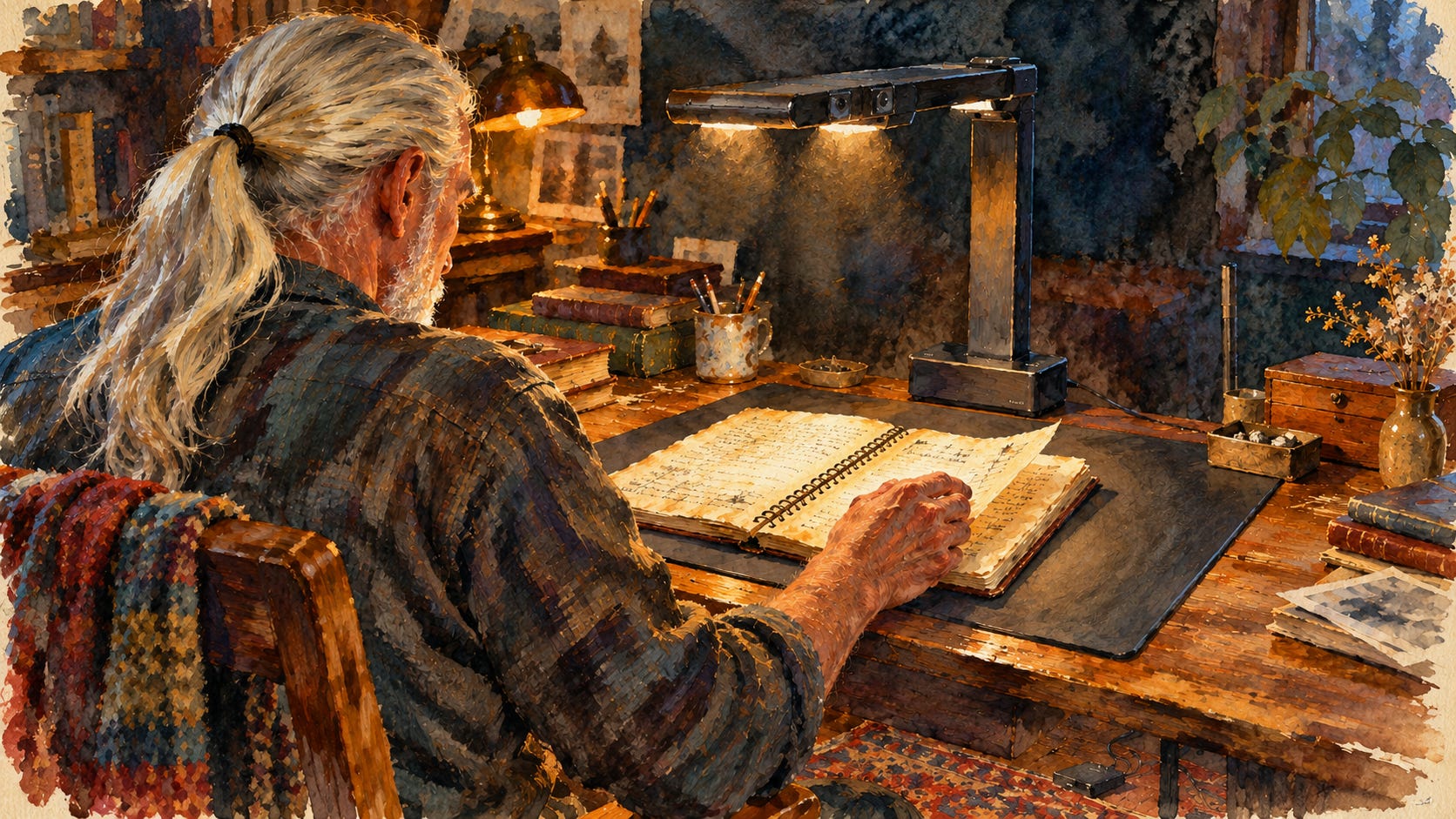
Last week, I bought a new scanner. I probably own more scanners than rolls of toilet paper. So buying another was a signature moment and utterly mundane.
I try, when I buy a scanner, to have a good reason. And, in fact, I always do. It’s just my ideas of what I want to do with a scanner are almost always eons ahead of what any particular scanner is going to actually help me do.
But.
I think we’ve — at least I’ve — finally arrived at a point in history where my reasons for wanting a scanner and the scanner’s actual capabilities have finally meshed.
I’m a writer.
Now, that doesn’t mean what a lot of people mean when they say “I’m a writer.” Few of my words have been “published” in any spectacular venue. I think I had an article way-back-when that was published in some kind of medical transcriptionists’ journal. I wrote one chapter of Migrating Windows NT4 to Windows 2000 (Amazon Affiliate link) for them. Most recently, I had an article published in The Daily Journal, which is a rag read by lawyers, judges, and other people without something better to do.
Oh. And when I was in the fifth or sixth grade, I think, I had a poem published in the school paper about a tree. I can’t find an intact copy of it right now, so I have to go off the little memory I have:
Here the tree stands all alone,
     All the kids have gone home.
How it wishes it could play,
      Each and every single day.
Hey! I was in elementary school!
Eventually, we arrive at:
How it wishes it could be
And whatever it is that it wishes it could be, it can’t be. Because,
It is just my imaginary tree.
I have no idea why I needed an imaginary tree. There were plenty of real trees in my elementary schoolyard.
But I digest.
Point is, I’m a writer. Nobody famous. Nobody you’d know. And if I added up every penny I ever made from writing, I could perhaps buy myself lunch at Carl’s Jr.
Maybe.
Which would be quite fitting because what I’m about to tell you almost always happened at Carl’s Jr.
For decades now, I’ve kept journals. And for decades, I literally wrote them while sitting — for hours — thinking and writing at the Carl’s Jr. near St. Agnes Hospital in Fresno. Although, I must admit, that was not the only inspirational writing bar for me. Sometimes it was the Carl’s just south of Ashlan and Blackstone. Or the one on Jensen Avenue near 99.
As I said in one of my journal entries:
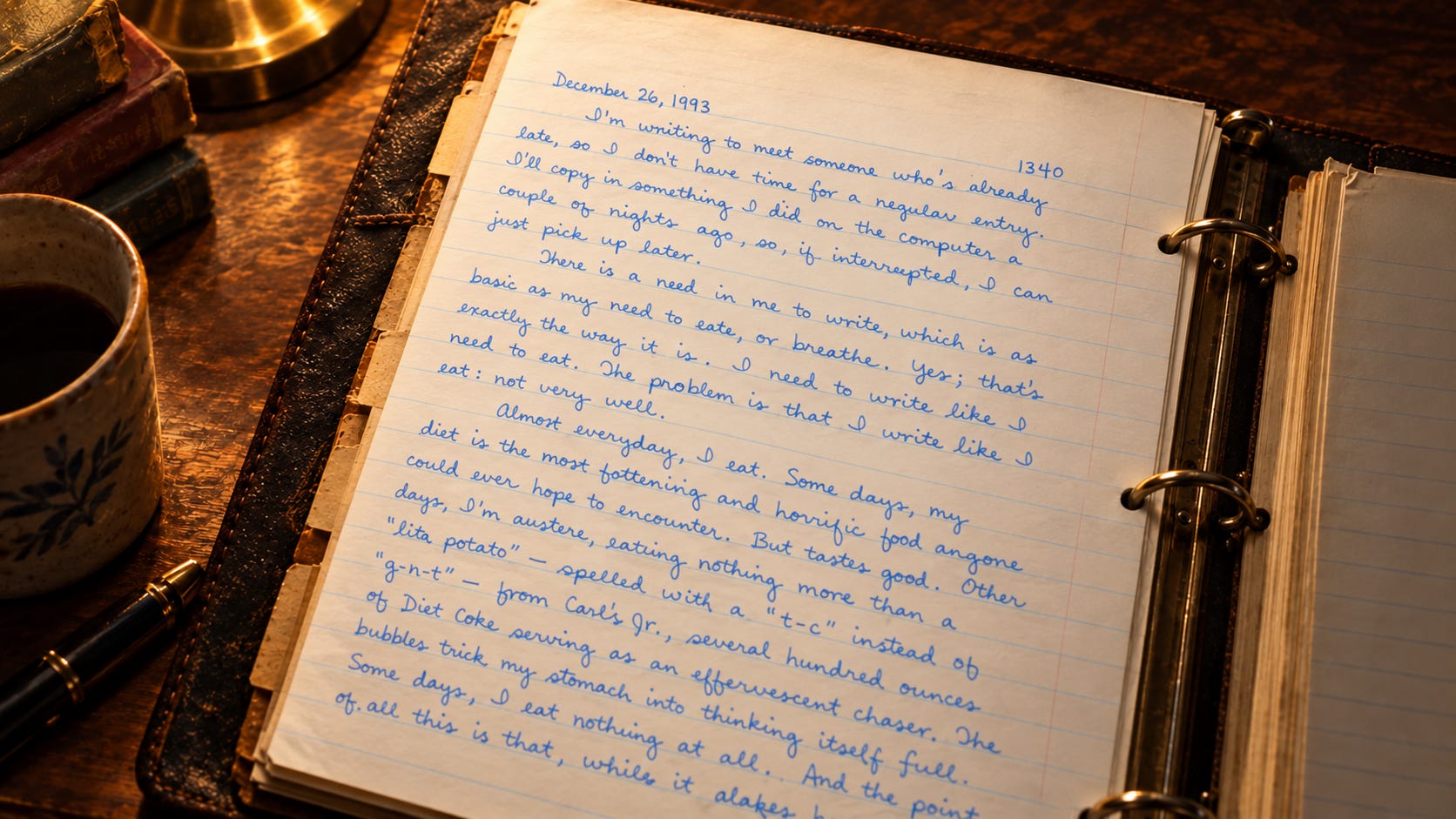
There is a need in me to write, which is as basic as my need to eat, or breathe. Yes; that’s exactly the way it is. I need to write like I need to eat. The problem is that I write like I eat: not very well.
— Rick Horowitz, Personal Journals (December 26, 1993)
Fortunately, the way I often arrived at Carl’s was via rollerblades. Most days, I covered around 30 miles. My backpack gradually lightening along the way as I delivered the medical transcriptions I’d worked on after awakening at 4 a.m. and working through to about 7 or 8 before rollerblading to the university for classes and the various offices and hospitals to deliver my work — that’s why I often ended up at the Carl’s Jr. near St. Agnes.
Of course, I’m not the only person with this need to write. It’s been a part of human history since at least — and there’s a certain absurd aptness that connects to the connection I already had between eating at Carl’s Jr. while I journal — around 3300 BCE when the earliest surviving cuneiform tablets of Mesopotamia were used to keep track of food.
Millennia later John Locke would write in his famous 1685 treatise, A New Method of Making Common-Place Books, about a system that tried to solve the same problem for which I bought my book scanner: how to find what you’d so painstakingly written. After all, what good’s the preservation if you cannot later find what you’ve preserved?
Locke’s system utilized an index at the start of a common-place book. As he put it, “This is the index to the whole volume, how big soever it may be.”
I didn’t index my journals. I don’t know how I could have. But after scanning them, I’ve found that some single volumes contained hundreds of thousands of words. The total word count across all journals is about half a million!
But as Virginia Woolf said in an April 20, 1919 diary entry, when I would periodically pick up an old journal and read, I “found the significance to lie where I never saw it at the time.” Earlier she’d doubted that her diary counted as writing. Like me, though, she valued the strays caught there, the “diamonds of the dustheap.” She was about to turn thirty-seven when she wrote about the task she was leaving for her 50-year-old self.
Partly for the benefit of this elderly lady (no subterfuges will then be possible: 50 is elderly, though I anticipate her protest and agree that it is not old) partly to give the year a solid foundation I intend to spend the evenings of this week of captivity in making out an account…. The lady of 50 will be able to say how near to the truth I come; but I have written enough for tonight (only 15 minutes, I see).
— Virginia Woolf, Diary Entry (Jan. 20, 1919), in A Writer’s Diary: Being Extracts from the Diary of Virginia Woolf 7, 7–8 (Leonard Woolf ed., 1953).
I sit here at 68, trying to find my “diamonds of the dustheap,” prying through the accounts I’ve made.
And 50 does, in fact, seem to me young!
Montaigne had proposed “a life ordinary and without lustre[.]” That has certainly been mine. But like Montaigne, I have not “form[ed] a man; I only report him: and represent a particular one, ill fashioned enough[….]” Like Woolf’s diary writing, my journaling “does not count as writing[.]”
And despite the echo of “a life ordinary and without lustre,” my “Nobody famous. Nobody you’d know.” is true only of me; hardly of them.
In that same essay, Montaigne said, “I do not paint its being, I paint its passage” and “I must accommodate my history to the hour.” This thought — in reverse, and without my having it in mind at the time — was the genesis for looking back at my old journals. I wanted to know who I was, who I am, how and who I have become.
But it is a futile quest because, as I would have learned from Montaigne, had I read him before I started, so much is left out. I did not — I could not — fix my object: “‘tis always tottering and reeling by a natural giddiness.”
That natural giddiness is life itself. It is ever shifting. Journaling has been my way of trying to pin something down. That may not be the best use of it. As Amy E. Spaulding wrote in her book, The Art of Storytelling: Telling Truths through Telling Stories, “Truth, like story, cannot be written in stone, for it dies when it is solidified.” She went on to note that the first person to write down the Hindu sacred scriptures was called “the butcher of Veda” because he trapped the Veda on paper, instead of letting it continue to live.
And yet.
And yet.
The natural giddiness of life makes it difficult to examine otherwise, especially over longer spans of time.
In November of 1982, I wrote that my journal was a fairly accurate record of my feelings, though less so of events. In 1983, I objected when interpreters left jokes out and deaf listeners saw everyone else laughing without knowing why. January 1990 found me arguing (something I still believe today) that you can know a Self only historically: by the time you describe it, you’re already describing its past. My March 1994 conversion to Judaism — though my father was raised an Orthodox Jew, my mother was not a Jew — shows me expressing my commitment to community and tikkun olam. And in 2020, defending a woman facing prison, I tried to get a judge to look at the photograph of the baby who would be separated from her. (The judge refused.)
When I gave all my journals to an LLM — yeah, I know, I know — I did it because I wanted my handwriting transformed into searchable text. Then I got the bright idea to ask for an analysis.
Twice.
The first time I did it, the AI only had two journals. And the analysis was, for that reason, a little off. The second time, all the journals were there except the one I currently carry with me, which is not yet complete.
The first analysis wasn’t false. It was just an incomplete death of truth. It pointed to my recurring struggle to feel adequate — as a writer, as a thinker, as a good person.
The second analysis gets closer to what feels real to me:
Here is the throughline I see now: you keep trying to understand a person—including yourself—without mistaking your account of that person for the whole. You want what you learn to change how you act. You have pursued that through religion, language, philosophy, relationships, teaching, law, and writing. Those pursuits have changed you; they aren’t interchangeable names for an unchanging Rick.
Pablo Picasso said, “There are painters who transform the sun into a yellow spot, but there are others who with the help of their art and intelligence transform a yellow spot into sun.” And Amy E. Spaulding said, “Each of us is a storyteller from the moment we are born and cry out our first sounds: ‘Here I am! Where am I?’”
I’m a writer. Most of my writings are “private” — I use the quotes because I did give them to an LLM! — and personal. I was born as a pale white wailing spot. And I believe the first sounds I cried out were probably “Here I am! Who am I?”
At 68, I still have hope that with the help of my art and intelligence I’ll someday have transformed that pale white wailing spot into something that deserves to turn and gaze with a smile before I’ve lived my last day under a glorious sun.
On March 6, 1993, I watched birds scatter seeds from a real tree at California State University, Fresno. I considered how each tree was shaped by its particular history. Later that same day, I wrote that a Self is real but cannot be seen directly; we infer it from traces such as notes — journal entries — and footprints.
But because of the giddiness of life there is always something that is missing.
I’ll continue to journal. I’m a writer. The butcher of Rick’s life, maybe. No. I don’t think that’s true. I think what’s true is what Socrates said. “The unexamined life is not worth living.” Or, at least, those are the words Plato trapped in writing as what he said.
That has been the struggle of my life, which drives me to think and drives me to write so that I can both think things all the way through and see what it is that I have thought, who I think I am, and who I think I want to be.
I just need to remember, when I write what I will read and I read what I have written that whatever it is that I may think I want to be, what I’ve captured in writing is just an imaginary me.
Until that last day, the picture will be incomplete. For as Søren Kierkegaard put it — in an 1843 journal entry — “Life can only be understood backwards, but it must be lived forwards.”
Beautifully written by a man with an outstanding mind.