

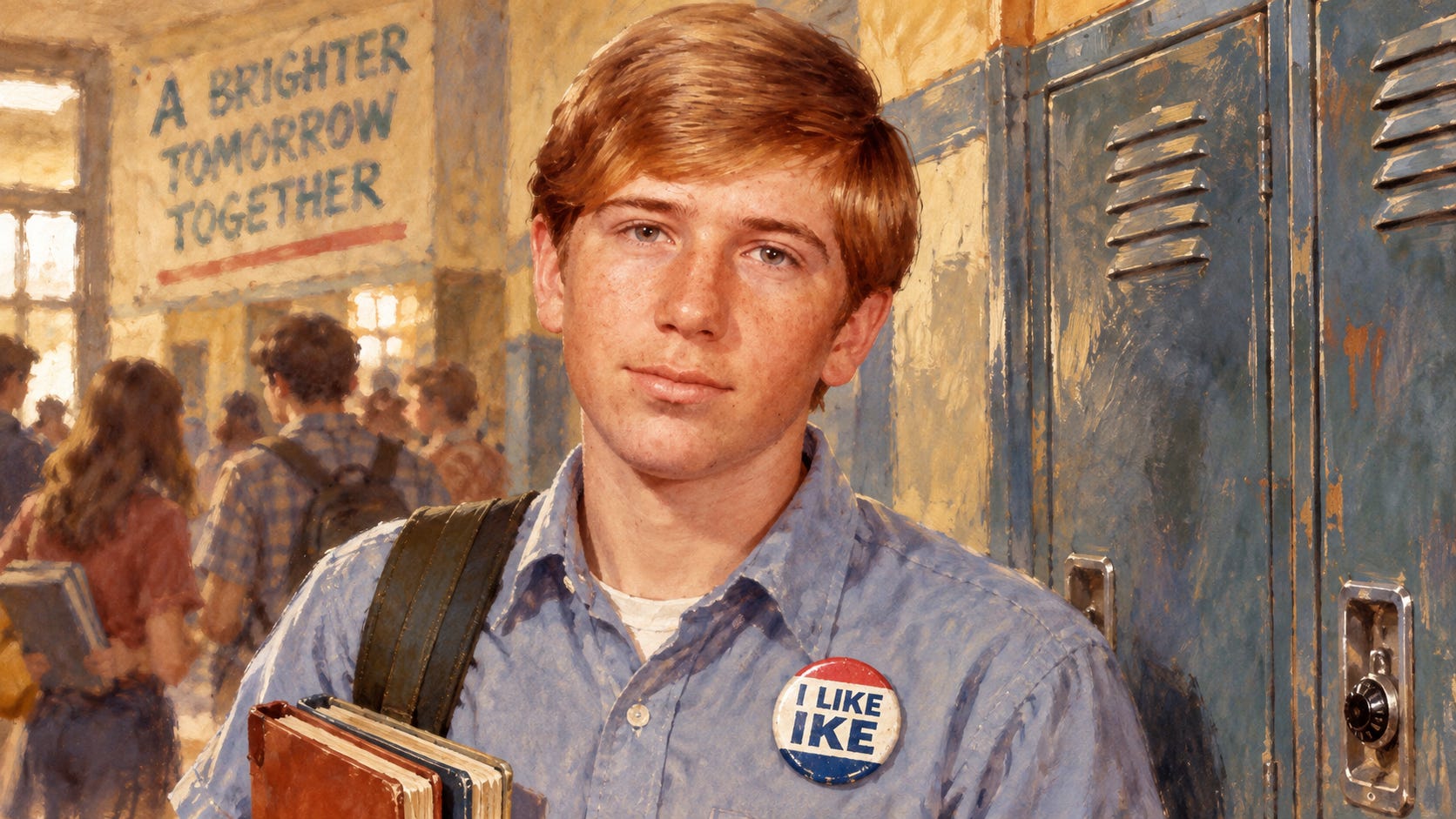
When I was in my teens — and at fourteen I wasn’t old enough to vote yet — I somehow ended up working for the McGovern campaign for President.
It was my first exposure to the actual work of politics and I cannot tell you, in all frankness, how I became involved with that campaign. I must have liked something about McGovern, because I cannot imagine that otherwise I would have done what I did. It was a lot of work. I stuffed envelopes. I wrote out postcards. I went door-to-door handing out information pamphlets and, I think — come on, do you know how long ago fourteen is to a sixty-eight-old?! — trying to answer questions. We had these little mini-rallies.
Anywayser — that’s a familect of mine, by the way, passed down in my family for one generation — as a child, I was horribly offended by “injustice.” I didn’t call it that then. I don’t know if I understood, fully, the word. It wasn’t part of my vocabulary. But, as an adult, I recognize that this attitude of being offended by injustice has been a throughline in my life. I have ideas about where that came from.
But those are for another essay.
I also remember that I had this little lapel button. Of course, I didn’t have a lapel back then, except on church days, and I was not allowed to wear my lapel button then. LOL!
But I wore the button to school sometimes pinned to whatever shirt I was wearing. It said, “I LIKE IKE”.
Now, I don’t exactly remember why I liked Ike, but I did.
Maybe it was the story of what he did when he was liberating those who lived through the concentration camps and how he had certain people—Germans living in the area, including mayors—brought to the camps and forced them to see what they had enabled. Maybe it was something about his photos. I remember that I always liked his face and his uniform. He just seemed so…stately. Yet friendly. Warm.
Moral.
Like, this is the man who is going to stand up to the whole world. He’s not letting anyone tell him to stand down when something is wrong.
I needed that at that stage of my life. I need it now.
There is a certain irony to that election cycle. In 1971, Amendment 26 to the United States Constitution was ratified. I was 13 years old. A year later, in 1972, McGovern’s campaign for President — the one I worked — was launched. Today, some call this the presidential election campaign that essentially torpedoed our nation.
But I digest. (There are enough of using the word this way that I can imagine a future where “digress” and “digest” get listed in the dictionary as synonyms. Or maybe it goes the other way: maybe “digest” keeps its meaning, but hides the nuance that digestion doesn’t eat everything and so, along the way, a little shit pops out now and then.)
There’s something to be said for expertise. There are people in the world who study a particular thing, or come to know a particular — what shall I call it? either “need”, or what I think is oddly connected, “zeitgeist” — “requirement of this time” that the hoi polloi (I include my 14-year-old self here) miss. They actually “get it” and we “feel it” in a way that might be, in the end, just wrong.
That’s what happened to me when I was younger. I sensed things. I felt them. And I responded to those feelings. I worked for McGovern. I liked Ike. But things started to change a little when I voted for the last Republican President I would ever vote for: Ronald Reagan.
Before I go on, I want to say that I decided to write this essay because of an essay Dan Rather from Steady wrote. Rather’s piece is rather partisan and I wanted to write but I wanted to try not to get too partisan. We’re going to see if I succeed at that. But I feel the need to say right here that I’m neither Republican nor Democrat. People who know me will laugh at me saying this, but I don’t really consider myself to be very political. In fact, I don’t even remember how I’m “classified” in California these days. I’m either unregistered or independent. I don’t know the label and I’m not going to look it up right now because, frankly, I don’t think labels fit me very well.
Confused, maybe. That might be a label you’d say works.
Except I’m not confused. I know why Reagan was the last Republican President I voted for — and I’ve voted for Republicans in other races until 2020. We’ll get to that later. But once again I digest.
The repeated digestion here is happening, actually, because trying to write this essay is giving me indigestion.
But anywayser, I am not confused. Reagan’s Presidency taught me something. And it did so through what I’ve come to call Trickster-Down Economics. You might know it by another name.
Or two.
Trickster-Down Economics is a play on what was already a sarcastic labeling for the popular policy name. To see that my name fits better you just have to remember that the core idea behind the policy was that giving financial relief to corporations and the wealthy would encourage them to invest, create jobs, and boost production, which would eventually "trickle down" to the middle and working classes.
It’s perhaps the only remaining core piece of formerly-conservative Republican policy — though maybe not known by any of these labels today — which has ultimately resulted in massive deficits, over $40 trillion in fact, and has brought us such things as tech bros trying to create new countries — or take over pre-existing ones. It’s something of a cross between a bad sad joke and a potential real threat to democracy (such as it is).
But I didn’t bring it up to rip Republicans. Because if you want to know what I really think about political parties, I am just as afraid of the freedom-hating Left of the Progressivism that is taking over the Democrat Party.
I brought it up simply because Trickster-Down Economics is the first thing that helped seal the deal, so to speak, on who I think I’ve become. It congealed my early feelings about truth and injustice and turned them into the driver that forced me to start learning real things instead of just running on those feelings. It drove me to get an edumacation in a variety of disciplines and work several disparate professional careers, before landing me in the maw of the law — as a criminal defense lawyer.
This happened because in retrospect, McGovern, Ike, and Reagan — aside from not being anything alike — maybe weren’t such wonderful people to whom I should have been unquestioningly attracted anyway.
Trickster-Down Economics was (and remains) voodoo. Reagan created numerous effigies — including the mythical, Cadillac-driving “Welfare Queen”, the steak-buying “strapping young buck”, and the Lazy Hippie — and used them as a smoke screen to dismantle the American social safety net. But having created the effigies, the pins he stuck in them ultimately hurt us all, puncturing the economic security of the very working class that voted him into office.
As with their descendants foisted on us by Reagan’s political descendants, these effigies, though, were built on lies; they were caricatures. Only instead of eating the cats and eating the dogs, they’re constantly eating the truth and feeding our society a great whopping helping of injustice.
Trickster-Down Economics did nothing to fix any of problems Reagan claimed to have identified. It did provide a rationale for redirecting money from social safety nets to the social misfits becoming millionaires and billionaires by running our world today.
I brought this up because it’s what first helped me to see that how I felt about someone — remember, I liked him; I voted for him; and I wasn’t completely lacking in knowledge about him because I’ve been living in California since at least the 1970s — but I learned a few things from Reagan.
One was that I needed to question my feelings. I needed to do that because not only was there something going on behind what Reagan was doing, but there was something going on behind my feelings.
This seems to me even more important today than it was when I first started to learn it. Because in one sense, it could easily appear that I’ve just done to Reagan what Reagan did to Linda Taylor, the “young buck”, or the Lazy Hippie he used to convince people that poverty was a character flaw rather than an economic condition: that I turned him into an effigy. That’s not the case.
Politics today is fueled principally by lies.
Wow. Did you hear that? (Or were you one of the ones who shouted “DUH!”?)
I know lying and politics go together like George H.W. Bush and Willie Horton.
In fact, they’ve gone together since the very beginning of our nation, founded on a lie about honesty. The entirely fabricated myth of a young George Washington confessing to chopping down a cherry tree because he “could not tell a lie” is itself a lie.
But there is a reason I use the word principally to describe what fuels politics today. Things have gotten astronomically worse. Parson Weems invented the cherry tree myth to build a shared moral standard, using a fiction to elevate the virtue of truth. Today’s political lies do the exact opposite: they are designed to assassinate the very concept of truth. We have moved from aspirational myths to a cynical, scorched-earth reality where the goal is to make us believe that nothing is true, no one is honest, and everything is an effigy.
We didn’t get here overnight. Going from Reagan to what we have today with what filmmakers call a jump cut or a smash cut would be disingenuous. It also skips over something else. I didn’t get where I am overnight, either.
So let’s lay another section of the road that brought us all here.
Colin Powell's presentation to the UN Security Council in February 2003, where he stated with total confidence that Iraq had mobile biological weapons labs and was actively concealing a weapons program did something George Bush — and the people around him — desperately wanted to do.
This is when I first became aware of the importance of paying attention to what I call the satellites of the Presidency. Dragging the American public to a questionably-legal war long before the current illegal Iran War — which the current lie says isn’t a war, anyway — were the intelligence community’s claims, Congress’s authorization vote, the media consensus that amplified Powell’s speech — that's the machinery of enablers operating around one man’s presentation. It’s the first time I recognized a reason to distrust the apparatus surrounding a leader rather than just the leader himself.
And it became particularly disheartening in the years that followed because I liked Powell in much the same way that I liked Ike. Powell was, at the time, probably the most trusted, least partisan-seeming figure in the Bush administration — a decorated general, measured, credible, believed by people who didn't trust Bush or Cheney. And although I initially thought the Iraq War was just as illegal and bogus as I think the Iran War is today, Powell’s public pronouncements made me doubt myself.
It wasn’t until much later that the Iraq Survey Group’s postwar investigation found no stockpiles and no active program. Powell himself later called the speech a permanent “blot” on his record. Not only that, but information that came out over the years — all the way up to comments he made in 2015 — show that Powell himself had doubts. He just never told us about them at a time when it might have made a difference to whether or not we were all gung-ho to support the bogus war effort.
Powell, at least for a while, excused himself because, as he would put it, he wasn’t the intelligence chief. He believed the information that was fed him. People around him remember things a little differently. And this leads us to a test; it shows us where we should be looking when those around the President are making their case.
It also shows why, after 2020, I quit voting for Republicans at any level of the ticket and not just for the Presidency.
The test is whether a public figure’s justification for what they did survives comparison with what they actually did. If it does not, the excuse was never really an excuse — it was cover. It was a lie.
In 2016, “justice” Scalia suddenly died in his sleep — an undeserved reward granted by the gods, fate, or, to put it in terms of things that really exist, a myocardial infarction. Bernie Lomax, aka Mitch McConnell, stated within hours of Scalia’s death that no replacement would be considered until after the election. His stated reason was that the voters should decide who got to pick the next Supreme Court “justice”.
Never mind that they already had.
When President Obama nominated Merrick Garland as Scalia’s replacement, Lomax and Senate Republicans refused to hold hearings or a vote, leaving the seat vacant for 293 days.
This became known as the “McConnell Rule”: a Supreme Court vacancy shouldn’t be filled during a presidential election year so that the voters could have a voice.
In 2020, a mere seven weeks before the end of Trump’s first term, a vacancy again opened up on the United States Supreme Court because one “justice” suffering from pancreatic cancer could not see her way to vacating her position before Death ripped the position from under her.
You can argue the wisdom of this decision however you like. As you can guess, I consider it a major miscalculation. One that has probably changed the course of history and will have repercussions for at least 40 years, if not the remainder of our existence as a nation (which, now that I think about it, could be a much shorter time).
What you can’t argue about is what happened next.
With just about a month-and-a-half until the election, the McConnell Rule deemed that there should be no Senate vote until after the voters decided who would make the choice on a replacement “justice”.
So, of course, the McConnell Rule vanished into thin air. Amy Coney Barrett was rushed through a vote, creating a new 6-3 conservative Supreme Court and leading directly to overturning a half-century of law that all those conservative “justices” had indicated they could not see being overturned.
In 2024, Trump was re-elected. Having learned from his first term, he began appointing people based on his own version of DEI: qualification for a position was based not on expertise, knowledge, or even a remote understanding of the position, but on whether or not the appointee was deemed loyal enough to Trump.
Among those appointed to positions for which they were not qualified was Pete Hegseth who began remaking the military in his own unqualified, but loyal, image.
Hegseth fired General CQ Brown and Admiral Lisa Franchetti with no explanation given, but he’d already written in his own book that he questioned whether Brown’s promotion reflected merit “or his race.” The old version of DEI and “wokeness” were targeted for elimination along with those Hegseth believed benefited from them. Only Trump’s version of DEI would survive.
Months after firing the General and the Admiral, he personally intervened to strike four Army officers — two Black men, two women — from a promotion list that had already cleared the normal process, over the Army Secretary’s repeated objections. Reporting puts the total blocked at six.
The Pentagon’s denial — “meritocracy... is apolitical and unbiased” — opens a gap between Hegseth’s constant complaints and the truth: the Pentagon’s stated principle and the documented pattern of who Hegseth blocked don’t square.
This essay — at least partly because it literally decided to grow in a direction I was not planning when I started — is already too long. Plus any discussion of the prevarications and deliberately disinformation from the man at the top are not only obvious: they’d be redundant.
I don’t expect I’ll write anything this “political” on this Substack again. (Although I’m not going to fall into the trap of making this a promise.) It started with memories of my earliest involvements in politics and how I thought the reason I like Ike is because he refused to allow the Germans to make excuses for what they’d done and made them look at the evidence. I said that I liked him because he was the man who was going to stand up to the whole world. He wasn’t letting anyone tell him to stand down when something was wrong.
I said that I needed that at that stage of my life. I said I need it now.
But Ike is long gone, so I guess I will have to fill that need myself.
As an interesting coda to this: when I first started writing and I had written only up to the part about Ike, Bunny Chafowitz got excited and said, “I have something I have to show you!” She quickly left the room and almost as quickly returned.
She handed me a small pin.
“This was my grandmother’s.”
I think I’ll wear it on my lapel when I go to court next time.