


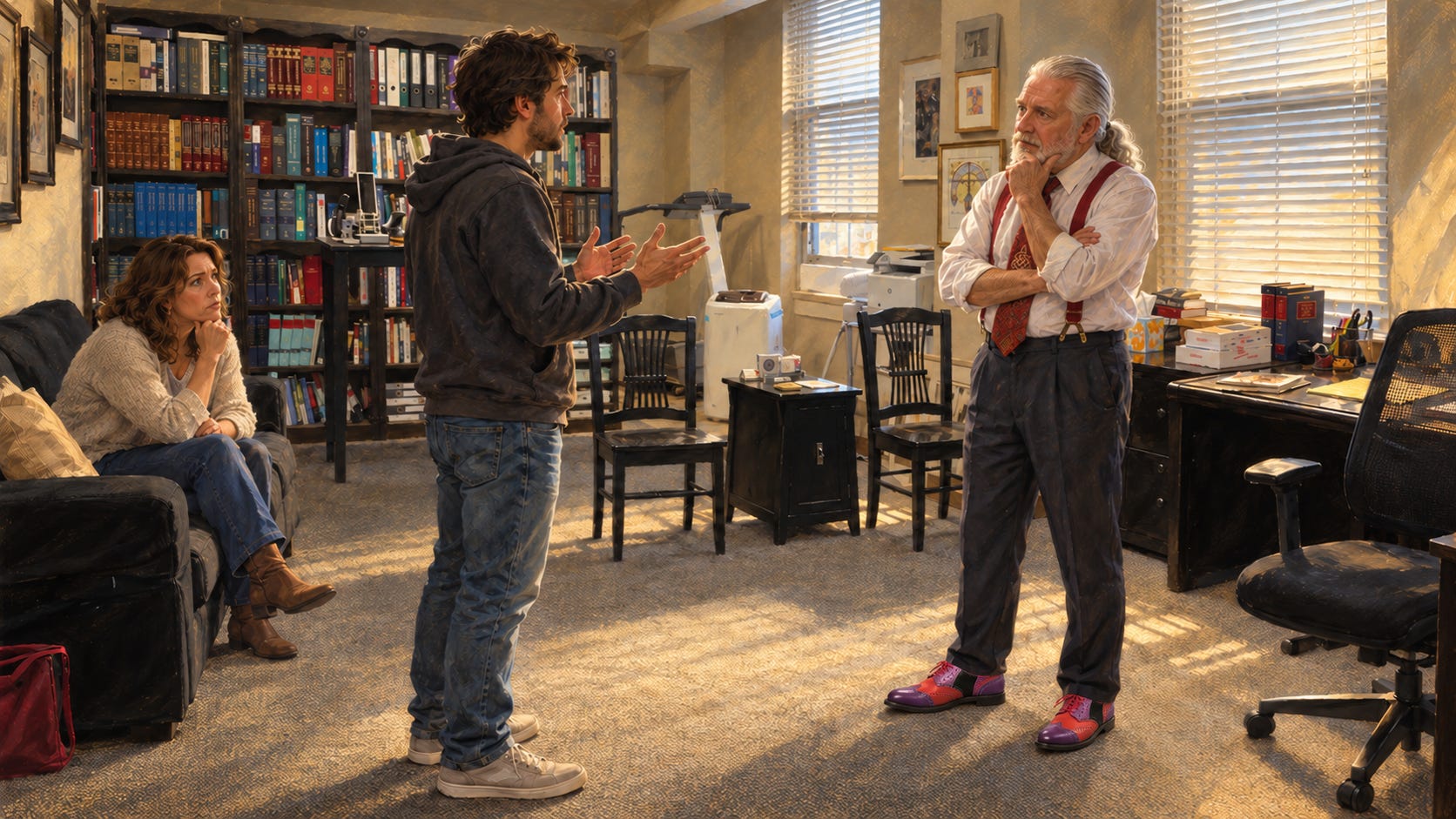
Johan — not his real name — came to my criminal defense law office with a problem. A couple of nights earlier, he’d been arrested. The charge was domestic violence. He brought along his mother, though she looked young enough to be his sister.
This was one of those times when I decided that to get a better picture of what had happened and to help Johan here with remembering, I would help him act out what had happened. Johan played himself; I took the part of a skeptical law enforcement officer.
Not my favorite part, but I play it well if I do say so myself.
My office hasn’t always had this useful configuration. For nearly 23 years, starting when I opened my first office as an “Independent Law Clerk,” my set-up was more traditional. You know the look. Impressive-appearing desk — in my case an old mahogany desk my dad had found me, stained black — sitting between clients with their families and me, creating the perfect barrier.
But in 2017, I took a trip to Wyoming that, in some ways, changed my life. It didn’t do so in exactly the same way it has benefited thousands of other attorneys both before and after me. Nevertheless, the changes have been profound.
In 2017, I was still not flying. I had not flown since my first encounter with the newly-implemented TSA in early 2002. I’d sworn that I’d never fly again. But TSA needs another essay and I mention it here only to explain why I drove 17 hours, spent the night at Stagecoach Inn at Dubois, Wyoming, before heading out to “the Ranch.”
The Ranch — Thunderhead Ranch — was a fitting setting for the “out there” experiences that were about to come. After turning off the highway, I drove miles on the dirt road, deep into a rugged, sweeping valley following the East Fork of the Wind River. The landscape features dramatic badlands, striking red rock formations, and wide-open pastures with the Absaroka Mountains looming in the background. Cell service vanishes soon after leaving the highway and entering the incredibly isolated area, surrounded by the Shoshone National Forest and the Spence and Moriarity Wildlife Habitat Area. By the time I reach the ranch gates, the modern world feels entirely left behind — which over the next few years I would come to realize is always a big part of the immersive experience for lawyers arriving there.
That night after supper, the upper hayloft of the Big Barn would be my introduction to the Trial Lawyers College Gerry Spence had founded there years before. Frank and I were paired off for an exercise.
Now, let me be frank — not Frank — for a moment: what I’m about to tell you, I don’t really remember all of it. I’m taking it from my journal entry of September 5, 2017.
I was told to pick one of my parents and then, as that parent, talk to my partner, who would play me, listening to — in this case — my dad. Per the assignment, I began with what it was like to witness the birth of my first child, Rick — whom I’d actually named “Richard” in honor of a childhood friend, Richard Burge. Then I talked about watching him go off to kindergarten; then, seventh grade; finally, high school graduation.
And so, with the smell of ancient dust and timber giving me a little boost of time travel and encouraging the fantasy, I began. As I wrote in my journal, “At first, I did not know how I would do it. But I decided I would really try.”
I was doing fine (I think) until the last one. Then I kind of lost it as I talked about how my dad and I (but as if I were him) had not been getting along for years. Talked about writing letters to my son, Rick, while I was out on cruises. And how I felt to have so much trouble getting along with him.
And then he ran away. I never got to see him graduate.
I had a hard time getting it out. I knew a little of how he had felt because in later years, Dad & I had talked about it. We talked about how much we loved each other, and of the struggles he had gone through in trying to make a relationship work with me.
I cried as I tried to tell the story.
— Rick Horowitz, Journal Entry (Sept. 5, 2017) (unpublished personal journal) (on file with author).
Thus was I introduced to “psychodrama.”
Around 1911, in Vienna’s Augarten, a group of young children sat around Jacob Levy Moreno, a Romanian-born young man raised in Vienna. He was then about 21 or 22 years old, not yet a doctor or psychiatrist — he earned his medical degree in 1917. But he was much interested in philosophy and children’s improvised play.
Later, on an outing in Vienna’s Prater — according to one of the children, Elisabeth Bergner — Moreno asked each child to invent a fairy-tale character and decide what happened to that character. At some point, he organized theater with them, including rehearsed plays. Bergner’s first part was in Molière’s The Imaginary Invalid. Perhaps presaging experiences like my own, Bergner remembers that some children disliked the game and so stopped coming.
But the children who stayed….
Freud, writing in the same city, had wondered what becomes of play when children — who are so freely creative and outspoken as children — grow up. What happens to this play?
Freud’s answer was that adults still fantasize. They just keep those fantasies private. And, interestingly, our heroes cross paths here.
Freud — for reasons I won’t try to psychoanalyze here — liked to hang out by the door after he’d given a lecture. As he shook each hand, he would ask what the attendee thought, or what they were working on.
By that time, Moreno’s theories were already somewhat developed. Moreno was shifting to therapeutic treatments of adults, using what he had learned from the children.
And so Freud and Moreno had a brief — a very brief — conversation at the door after one of Freud’s lectures. According to Moreno, when Freud shook his hand and asked what he thought of the lecture, Moreno said, “You analyze their dreams. I try to give them the courage to dream again.”
Those days are ancient history to our time and those theories — at least for Freud and another student of his, Jung, who I hope yet to get to — although not ancient, are old. And decrepit. But Moreno has been reborn in a segment of criminal defense practice thanks to the work of John Ackerman, John Johnson, John Nolte — I’m not even going to ask why Gerry was hanging out with all those Johns, but he was a criminal defense lawyer — and the eventual creation of the Trial Lawyers College.
And I could do an entire set of essays on the Johns.
Suffice it for now to say that John Johnson was a close friend of Gerry’s and a mental health professional. John Nolte was one of the Trial Lawyers College (TLC) original psychodramatists. And it was John Ackerman who invited Johnson to Houston while Gerry was there, when Johnson proposed using psychodrama to teach lawyers.
The three tried it on among themselves, with a few others, that summer. Then with a workshop for lawyers that fall. And, finally, in 1994, Gerry called in Johnson again, who brought in Don Clarkson, who recruited Nolte.
Long story really short, they hit upon a way of thinking and a way of training that led to the idea of “lawyers as real people.”
In fact, at some point, we adopted the ideal of The Velveteen Rabbit who became both a reminder and a mascot. In one of my many years spent at Thunderhead Ranch, I bought a copy of the book and various students and faculty signed it — much as we’d done in high school — again connecting who we were with who we were becoming.
And that’s really what Gerry was all about: becoming. He’d started way back in the 1960s with various philosophies that I’d also encountered and became uncomfortable with as having too close an affinity with pseudoscience.
Pseudoscience.
It’s only appropriate that I now come clean.
I went to Wyoming yearly from 2017 until COVID shut everything down. After that, or during that — I don’t really remember — there was some nastiness I don’t even want to get into between Gerry and the TLC Board. A lawsuit and countersuit (IIRC) ensued. The upshot was that Trial Lawyers College as I knew it came to an end. Today, the Gerry Spence Method has the Ranch and TLC exists, as I imagine it, in exile.
Which means neither the Spence Method nor TLC are the same. Nor as important to me. I have, after all, always had an uncomfortable and, at times, tenuous connection with both.
Going back to my September 5, 2017 journal entry, immediately after the passage I quoted earlier in this essay, crying about my father wasn’t what really scared me. What really scared me, I wrote, were the trial exercises.
At that point, I had not yet understood (as I soon would) that TLC had very little to do with being lawyers and much more to do with being lawyers. That is, the focus was not so much on what we did as it was on who we were.
As I put it in a journal entry written the first time I was there — in the moment — with my first impressions fresh, but uninformed — I feared “The part where what kind of LAWYERS we are will show.” And I didn’t consider myself then — often do not consider myself now — to be much of a lawyer.
But as a person? Through my journaling and working with numerous therapists, I’d already done a lot of what TLC was having us do. And I had concerns because some of the activities seemed reminiscent of the pseudoscience Gerry had invested in when he was younger. For example, one year we built — and sadly I didn’t journal this, so I am relying on bad and poor memories (“bad” and “poor” are not doing the same work here) — some kind of spirit circles. We were told to collect certain items. I don’t remember what they all were now. And we put them into this circle somewhere on the Ranch “that had meaning for you and was secluded enough not to be trampled or disturbed” and then watch them over a period of days. We were supposed to learn something from this.
I learned that I needed to be picky about what I collected. Not for my circle, but for the lessons I would take away from TLC that would improve my life and my law practice.
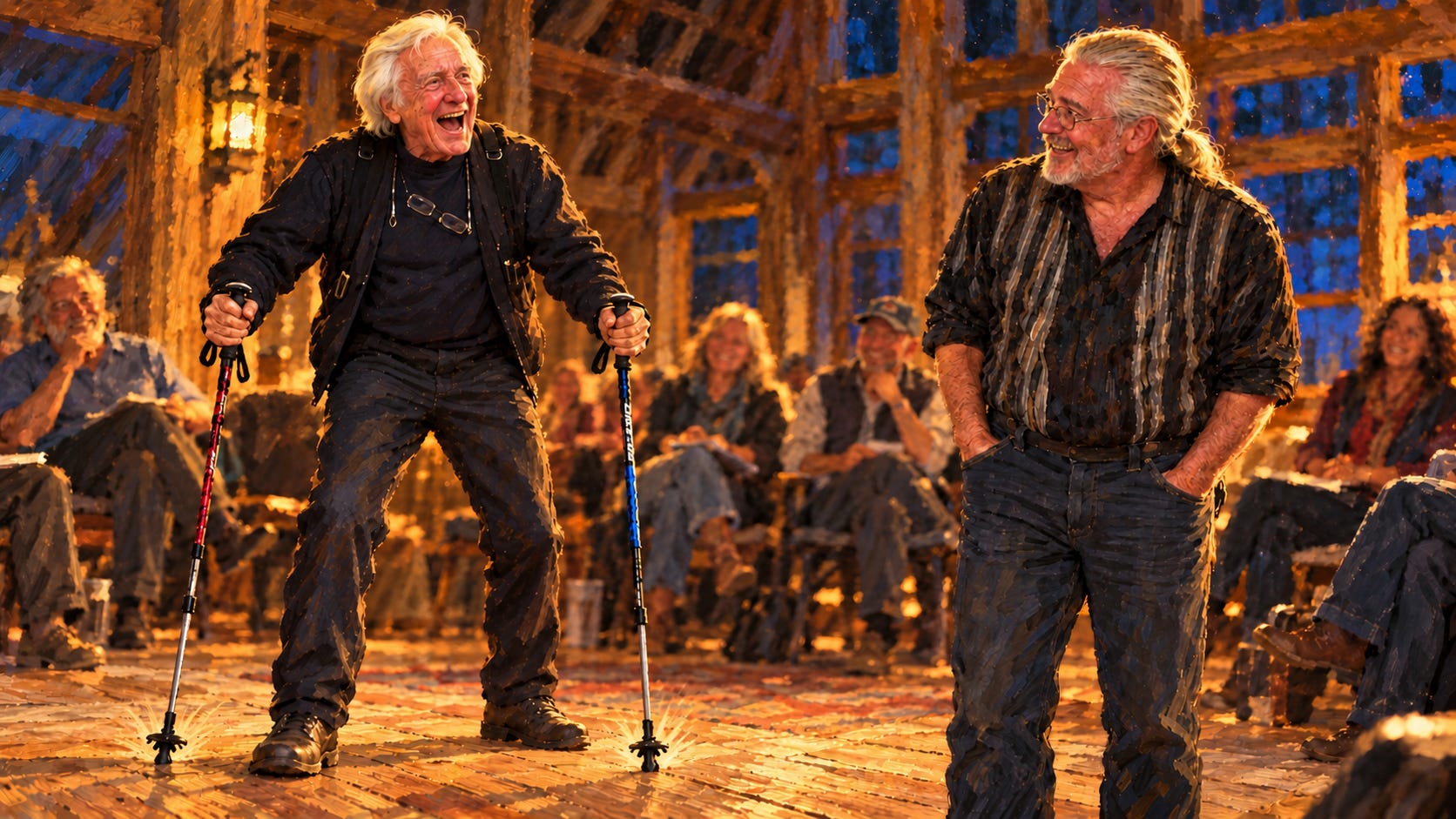
For example, though TLC focused quite a bit on psychodrama, there were also other things that happened that I personally found more useful. One night, there was an exercise on how to deal with jurors on a topic that most judges will shut you down on: jury nullification. Several people had taken a shot at it. Many did okay. Then I got a turn. Gerry was there; in fact, I’d been sitting right next to him for most of the night. When I got up, I remembered that Gerry is always talking about trusting the jury to do justice. So, when asked about jury nullification, I literally responded by saying that I couldn’t tell them what to do. The point of the exercise was handling the question in jurisdictions like California which say that jurors have the final word on the verdict — but jury nullification is technically not allowed, yet can still happen — and lawyers are not allowed to talk about jury nullification. But I just wanted to assure them that I had faith whatever happened when they went back to deliberate, they would do justice.
Gerry used two ski poles to get around. And he stood up, shouted, “Yes! Yes! Yes!” and each time, he pounded the ski poles into the floor.
Another thing I carried home — and this actually earned me a dismissal — was when we workshopped one of my cases. I’m planning another essay just focused on this, so suffice it to say right now that I ended up giving a closing argument as told by a cell phone dropped at the scene of a crash by the real growers as they tried to escape police. (Spoiler alert: I didn’t want to do this.)
Both these instances taught me to think outside the box. But more importantly, they reminded me that I’m actually pretty good at thinking outside the box, even when I didn’t want to do it.
Ultimately, I also brought home the insistence on being there, being authentic, and learning to listen to what was not said as much as what was said.
What I did not bring home were most of the specific psychodrama techniques. I personally found some to be not only a little touchy-feely, but also a little — as we used to say about funky stuff when I was young — “woo-woo.”
Perhaps I was just a poor student and I misunderstood. But the psychodrama techniques involving the Empty Chair, the Chorus, Doubling, Mirroring, Soliloquy, to name a few — I just really could not get into them. A lot of it just felt like bad community theater.
But even bad theater requires you to look at how people move, how they shield themselves, and how they react when the script changes. So although I couldn’t bring myself to talk to empty chairs, or go through the theatrics of doubling, I did add something unique and significant.
Yet my law office isn’t the Big Barn. And I’m not trying to help my clients heal their inner child through psychodrama. What I am doing is a stripped-down, practical version of it to build a defense and probe Johan’s memory and give myself a more complete picture of what brought Johan to me in the first place.
Acting out — in this case with Johan playing himself and me playing a skeptical cop and occasionally using the TLC techniques of switching roles back and forth to get to what Johan remembers said, how in his mind people really moved, and what the actual interaction had looked like to him — gave me much more than a traditional interview across a desk ever would. Doing client interviews this way is like the difference between reading a book and watching a play or movie. When reading a book, the reader imagines the scene. That’s not what I want when trying to understand a case. Here, having been provided room — a space in which to show rather than just tell me his version of the story — Johan is the director making decisions rather than my own imagination filling in the gaps.
Standing in my father’s shoes in the Big Barn had opened my mind to some of the personal work I still needed to do. But now, back home, I’d also come to realize that my dad’s old black-stained mahogany desk was acting as its own hindrance to my work as a lawyer. It was a kind of stage prop — designed to keep me safe and detached from the very people I was supposed to be defending. It created an unnecessary barrier to the idea of “being there.” So the desk went out.
The open space came in.
I remember how energized you were when you came back from TLC (woo-woo stuff aside). I'm glad you were able to make it part of your history.