



I’ve started leaving my office a little earlier than I used to so that I could “beat the traffic.” The high point of the day is the drive up the ramp out of the basement garage.
This is Fresno, after all. No Lombard Street here!
And for a long time, this has worked well for me. Light traffic to the freeway. I stomp on the gas — my 2016 Prius V is surprisingly responsive and quick to take the hint — zooming up the ramp and even if there is any traffic by the time I’ve met up with the freeway I slip right in. Sixty-five miles per hour. Center lane.
Thing are going swell. Until I hit what I call “the swell.” Fresno drivers are perfectly happy to drive seventeen times the speed limit, as long as the road is straight. But “the swell” occurs when you reach the turnoff from Highway 41 North onto 180 and then — before you would realize you’re on 180 if you weren’t distressed at what you were seeing — onto 168 to Clovis.
Except something funny happens right at that point if there happen to be more than three cars on the road. (And gods forbid there should be an 18-wheeler!)
The Swell. A curve in the road.
And I didn’t name it that just because I often mutter, when I spot it, “Great. That’s just swell.” The word, as you know, can also refer to an increase in size or number, or to a wave, or a bulge. Or a hemorrhoid, when you think about it.
Here, it means all those things except that anything here is swell.
For a long time, I found myself not only cursing when I spotted it but wondering to myself, “How does this even keep happening?!” Because it just doesn't ever seem to have an explanation. No accident. No cop eyeballing everyone from the side of the road. (We’ve got an AI-driven Panopticon for that now in the form of Flock cameras and other doo-dads none of us even knows about.)
But my understanding has since made a 180-degree turn. Ninety degrees at a time.
The problem comes down to the space between.
And although that appears to encompass primarily the space between the car in front of you and the car behind you, that’s not all that makes this (so) swell. There’s a lot of other spaces that have to be considered about the space between.
There’s what I already mentioned: the space between the car in front of you and the car behind you. There’s the space between you and the car on your left (if you’re in the right lane) or your right (if you’re in the left lane).
And then there’s the space between your ability as a driver and that of the driver in each of the cars surrounding you: front, back, left or right.
Any one of those could be greater than the 90-degree angle in the turn that creates the swell.
But let’s talk about what we know.
Human beings are lousy drivers. It’s not entirely our fault. A big part of the problem is that even if you take a Driver’s Education course, you’re not likely to learn much about what really happens once a bunch of us get behind the wheel of a car. Nobody teaches us about zipper merges. And we’re pretty bad at being able to maintain a steady speed without help from advanced automation in our cars. I use speed control whenever I’m able so I’m always cruising along right at the speed limit. And I laugh when I see the drivers who pass me and then a mile later fall behind me only to pass me again a minute later.
“Foolish person! You need speed control,” I cackle.
Well, okay. I don’t really cackle. Though I do sometimes say those words and think about cackling.
Some years ago, Japanese physicists with nothing better to do collected cars on a closed course. The drivers were told to keep to a specified speed and distance, but it proved too much for them. Before you could start cackling, the system broke down. As the drivers began adjusting to the space between cars, a reverse shockwave rippled backwards, impacting the entire line.
To quote from one article where I read about this, “You’re not driving into a traffic jam,” says Tom Vanderbilt, the author of Traffic: Why We Drive the Way We Do (and What It Says About Us) (2009). “A traffic jam is basically driving into you.” He thinks autonomous cars will reduce this problem considerably.
So now I understand that(’s) Swell: one person hits the brake. Maybe they’re not a good driver when it comes to curves; maybe they’re reacting to a bad driver who broke the flow by going too slow. Whatever the reason the car behind that drive reacts a beat late, then the one behind her is later still. By the time that wave reaches me a half-mile back, it’s a dead stop for no visible reason. The curve that causes the Swell just tightens the space between cars whose drivers cumulative reactions to one another silently explain it.
Once I see something, I tend to start seeing it everywhere. (Well, I’m not alone in this. I’ve read that if you’re talking to friends about buying a nifty new red Toyota Prius, you’ll start seeing them everywhere.)
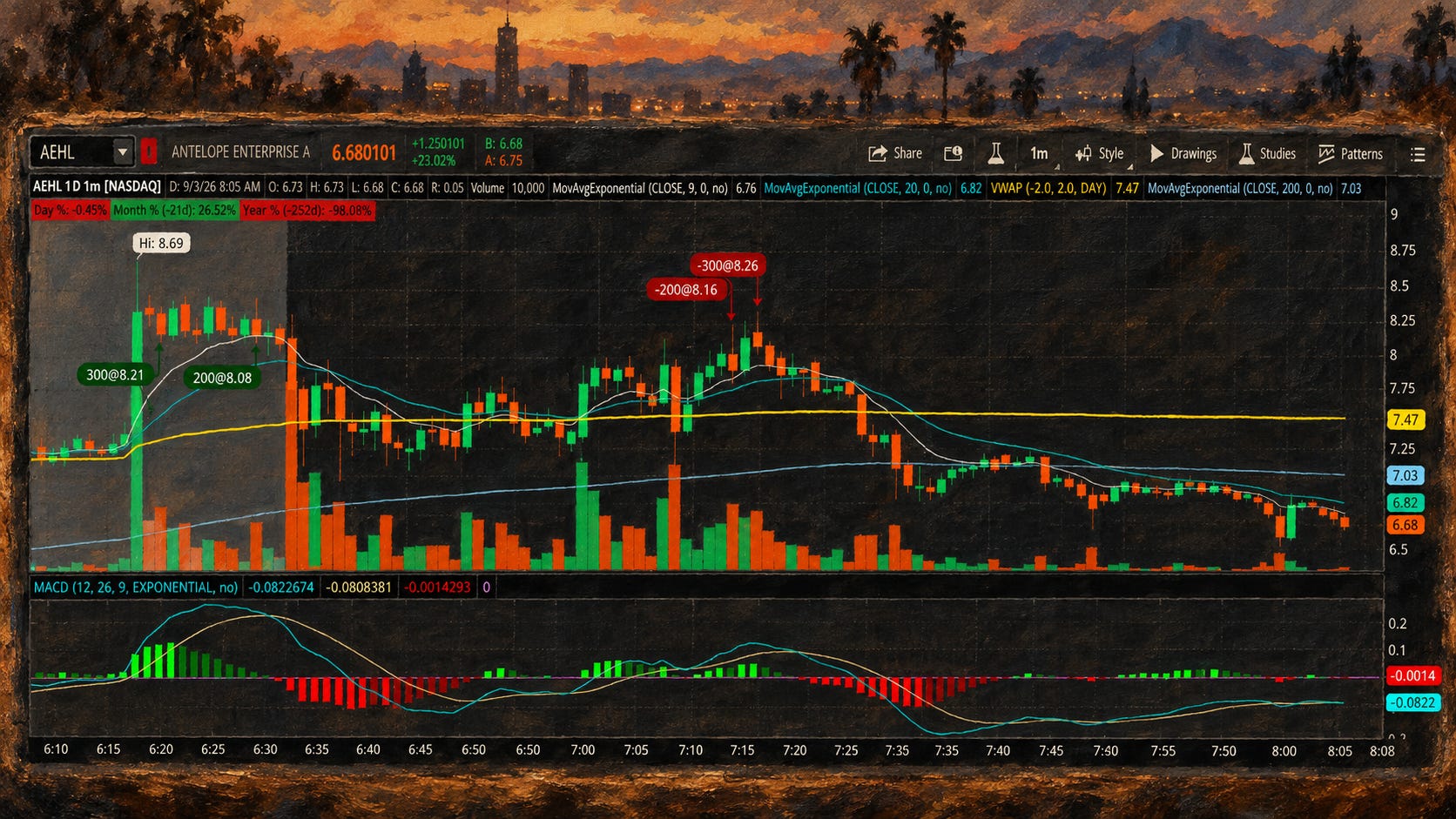
So a couple of days ago, I was working the market. I started doing this last November and found out I’m pretty good at it. I try to follow the techniques taught by Ross Cameron of Warrior Trading. I even broke down and started paying the $197/month non-members pay to use his 10-second charts — because through my almost-year-long love/hate relationship with Schwab, I’ve learned they’re probably never getting those — and his excellent scanners that help surface scalps.
Nothing was happening. And I was really itching for a scalp. It would be fair to say I had a scalp itch. I was watching a stock and I kept telling myself, “No, no. Don’t do it.” I knew the read wasn’t quite right. But there wasn’t anything else even as close to right as this wrong stock.
Then I saw that Ross had jumped on it. There was no space between his move and my reaction: I bought 500 shares.
And immediately regretted it.
But I’m a really sore loser. And I have something I call “the Cisco Rule”. CSCO was the first stock I ever bought in my life and I bought it at about $80/share right before the infamous dot-com bubble. Like all tech stocks, it crashed. By September 2001, it was trading for around $11/share. I didn’t do anything about it. Like Edward Hoagland in his famous 1971 essay The Courage of Turtles, I realized there was nothing I could do.
I walked away and left CSCO to drown.
You might say I gave it space.
And I’ve taken a huge turn — at least a couple of 90-degreers — since I started writing this essay. It often goes like this: I don’t know what I’m going to say until I say it. (Or, I guess, write it.) But the point here is that I gave CSCO 25 years of space. And when I returned to the stock market in earnest (or, more accurately, in November 2025), I realized CSCO had survived. Ultimately, I sold it when it hit $80; a move I now regret.
I’m slowly learning that my so-called CSCO Rule — hold a losing stock until it recovers — isn’t always the best rule. You could argue there are opportunity costs, though I find those negligible; I always have enough money for my trades. But, still, I don’t have many 20-year stretches of life left. So I’m learning to be a better loser and to cut my losses sooner — to get out while the getting’s bad and before it gets worse.
But, in the familect of one of my dear friends, I digest. We were talking about me following Ross Cameron into a bad trade and me, as I said, hating to lose. Because I said I’m learning to be a better loser. I didn’t say I’ve learned.
So Ross pulled off the road. He took his loss. (It was a doozy for him. He’s not driving a Prius, but more like a huge train.) I did not get out. I hung on. I think I literally hung on to the edge of my desk, fingernails digging in to keep me in my chair.
Sometimes the CSCO Rule works. It took just under one nail-biting hour but I came out with a profit of about $32. I got out fine. But as Claude later said, “the exits were good” and “the entry was good” are different sentences, and I knew it while it was happening.
I’d been following too close.
There’s an irony in all this. As I’ve gotten older, I realize that at heart, I’m a guy who believes in rules. They’re just not always the same rules everyone else follows. Or maybe it’s that I recognize there’s more than one rule and too many people get stuck on just one.
In a recent court case — in pre-markets I’m a not-so-mild-mannered trader, but in my day job, I’m an even more ill-mannered criminal defense lawyer — I had a client (who has given me permission to write about this) whom I was trying to get into a special program. Though I do have permission to write about this, I’m going to be spare with details.
Because what matters aren’t the details of my client’s case, but the fact that one driver — a judge — decided that the traffic flow was irritating and so she swerved. And then a whole bunch of other judges and “justices” followed her, disrupting everything.
Suffice it to say that this is a special program I’m talking about is one that judges and other prosecutors hate. It’s such a good program that, frankly, I think it should be the default type of judicial system: we should give up on the adversarial system being our court of first resort and make this collaborative court primary.
There’s a problem with doing that, though: it’s not vindictive enough. It recognizes that crimes are sometimes the result of mistakes and other times they’re the result of mental issues — I’m avoiding “illness” because sometimes they’re temporary breaks, as was the case here — and ditching vindictiveness would go too far toward making the world a better place.
By now you might be wondering what the hell this has to do with the Swell. So imma tell you.
There’s a whole bunch of case law that is, as we say in the legal world, “on all fours” with the case my client had which said that it defied logic to deny him entry into the program in question here. But as I’ve also said, judges and other prosecutors aren’t fond of the program for its lack of vindictiveness. And in certain cases, they really want — they even seem to need — that vindictiveness.
The massive amount of case law favoring my client is, here, pretty swell.
At least, you’d think.
Much of that case law is from 2023, 2024, 2025, and even 2026.
But there’s this lovely little case from 2022. And one particular prosecutor in a black robe found it.
It’s chock full of vindictiveness. It says, in essence, that if you don’t like all the other cars on the road, you can ignore them. Follow this one closely. You’ll tap the brakes and bring the entire line of case law to a halt. Like the original swell that opened this essay, it won’t make sense. (The court, when I said “this doesn’t even make sense” responded by saying “there are a lot of things in life that don’t make sense.”) But whether it makes sense or not, whether, as all the case law that came after it said, it defies logic, ignore all the space after it and hang onto its bumper.
Petition for admission to the program, denied. Petition for writ, denied. Petition to Supreme Court, denied.
The upshot? Only the space occupied by the 2022 case matters. You can safely ignore all that came before and all that comes after.
As for my client? After three years of not so much as a traffic ticket, his life is about to be destroyed.
Today, as I head back to my office, I come upon the 168-to-180-to-41 interchange from the opposite direction and a new problem confronts me: same Swell; different cause. Here, drivers must deal with a decreased number of lanes. Three lanes become two and the two become one.
Ideally, this would be handled with something called “the zipper merge”. All lanes are used right up to the merge point and drivers take turns entering the merge point from each lane. Doing it this way reduces bcakups, keeps cars moving, and (done correctly) reduces road rage.
But some people are too polite: they start merging early, leaving one lane moving slowly and at least one open and fast. They feel offended by those who rush down the open lane to the merge point, “cutting in line” with some even straddling the lanes to prevent this (which is illegal). Yet using all lanes can reduce traffic jams by up to 50%. Not to mention road rage incidents. Everyone moves at the same speed, leaving only a Swell as the slow moving cars slow down and speed up to accommodate the space around them and saving everyone 15-to-25 minutes in one Michigan location studied.
While moving through the space of this essay, I’ve used the word “space” in different ways. My ADHD brain easily connects the nuanced interchange of words. We’ve also seen cars hanging on one another’s bumpers, me hanging on to the edge of my trading desk, and prosecutors in a black robes hang tightly to the one case that pushed all others out of all judicial space.
For me, though, the most interesting bit of all is the way these points all fully inhabited the space inside my mind in under 90 seconds. Not that it was written that fast! I’ve often described — as only a man could do — the pain of birthing an essay to the pain of birthing a baby.
In the end, I leave it to the reader to decide if my use of this space was worth the ride.
Totally worth the ride!! I've known you for 32 years and still learn something new about you and the way you think every time I read one of your essays.