

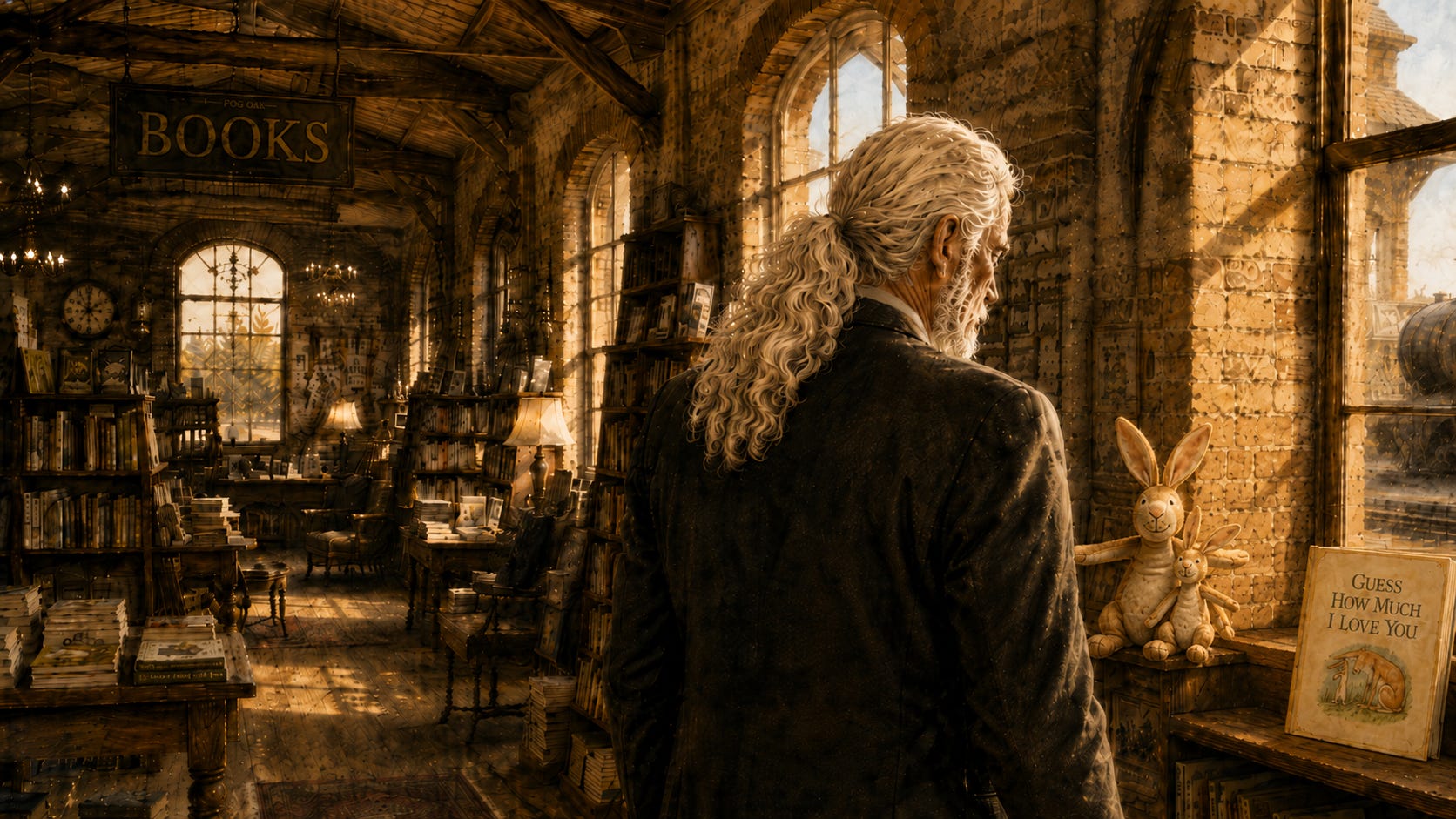
The minute I entered the bookstore in the converted train station, it was as if the bunnies began to flag me down. I’d come into the room not even knowing yet what was in it. I hadn’t seen any signage. I thought it was going to be just another empty room; maybe exactly what I was looking for. I was on a scouting mission in Merced for a new point of presence (nickname: POP) for a nascent Internet Service Provider we’d started building out of Fresno.
I made a beeline for the bunnies and discovered an accompanying book: Guess How Much I Love You. It was perfect. I immediately bought the bunnies and the book and brought them home to Bunny. She became Little Nut Brown; I became Big Nut Brown. Never mind that they were father and son and we were husband and wife. It was the love story. The distance to the moon. And back. We were, after all, over the moon in love.
That event spawned numerous new forms of address. You might say they began to breed like bunnies. Bunny, LNB, BNB, Little Nut Brown, Big Nut Brown. And, a little later, all those bunny names — it was just the two of us with enough nicknames for a large family — led us to getting married, which brought with it another naming problem.
What, exactly, were we to do about surnames. My name, common enough these days amongst people of Jewish descent — particularly if they happen to be descended from a particular Jewish rabbi (not rabbit), or, more accurately, rabbinical family.
The very first person to adopt the Horowitz name was a rabbi. Around 1391, a prominent Levite rabbi named Rabbi Joseph HaLevi fled persecution in Europe and settled in the town of Hořovice, in Bohemia. (So, yes, I’m proud to also claim that I’m a bohemian.) To identify himself, he took the moniker Ish-Horowitz, meaning “Man of Horowitz”. His descendants turned this geographical marker into their permanent family name.
When I say the name comes from a specific rabbi, though, I’m referring (as most do) to Rabbi Joseph’s most famous descendant: Rabbi Isaiah Halevi Horowitz (c. 1555–1630). He is widely revered in Jewish history by the nickname “Shelah HaKaddosh” (The Holy Shelah), named after his foundational mystical text, Shnei Luchot HaBerit.
Shelah HaKaddosh, before moving to Israel, was the Chief Rabbi of Prague and Frankfurt. So “Horowitz” became a famous Jewish surname because a specific dynasty of rabbis adopted a Czech town’s name as a nickname — more accurately in this case “moniker” — and passed it down. So if, like me, you trace your lineage back to a "Rabbi Horowitz," you are likely a descendant of this exact rabbinical line!
My dad often told me we were Levites.
And one of my mom’s nicknames was “PeePee” — not to rain on your parade here, but that was derived from the fact that some genealogy site suggested that she was a Polish Princess.
But that’s enough about rabbis (not rabbits), my alleged lineage, and me. Let’s talk about the Chaffees.
In 1965, Dr. Paul S. Chaffee was hired as the first formal director of what was then known as the Roeding Park Zoo.
To be brutally frank, even as a moniker the place hardly deserved that name. At the time, it was essentially a collection of tiny cages with pitiful primates and pent-up pacing predators. Most just laid there languidly looking at those who looked at them.
Okay. Enough with the alliterative alloys.
I do want to say more about “Doc” Chaffee, though, before I move on the core of this essay, because he was such an amazing man. (And not even on a sammich!)
You see, Doc wasn’t hired just as the first formal zoo director. He was also the primary veterinarian. And the “zoo” — again, it barely deserved that name — really needed both.
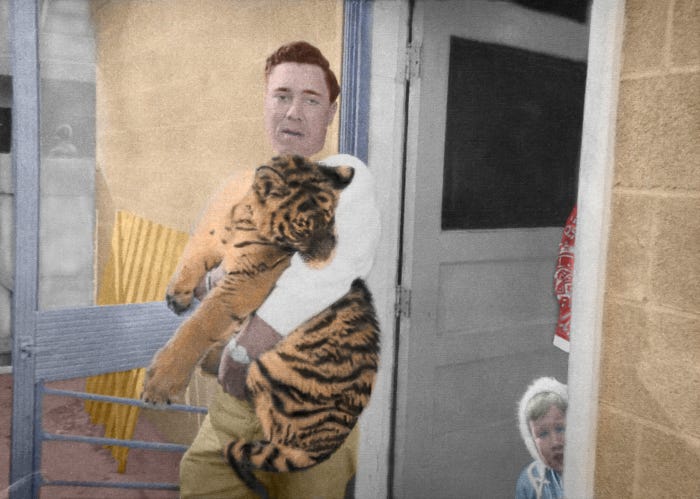
The “tiny cages” I mentioned weren’t just psychologically brutal; they were physically dangerous due to the extreme Central Valley heat. One of Doc’s first major legacy wins in the late 1960s was installing widespread climate control. He designed misting systems, proper shade structures, and cooled indoor quarters so that animals like the primates and big cats could actually survive and thrive in 105°F summers.
Before the mid-1960s, zoo animals across the country were often fed whatever was cheap, available, or thrown into the cages by visitors. Doc drastically overhauled the nutrition and quarantine programs. He established strict diets tailored to each species and built quarantine areas to ensure sick animals didn't infect the rest of the population, which massively extended the lifespans of the animals in his care.
Under his 25-year tenure, the facility underwent a massive cultural evolution. He helped steer it toward becoming an educational institution, introducing classroom spaces and the “Adopt-an-Animal” program. He laid the groundwork for the zoo's massive Walk-Through Rainforest Exhibit, which opened in 1988—a towering, half-acre habitat that was light years ahead of the concrete pens he inherited.
The now-named Fresno Chaffee Zoo is well-known as a world-class zoo. Many other zoos have copied Doc’s ideas and even expanded on them. It’s still one of the best zoos in the world.
And to think it started from what were essentially just crummy crates of critters.
Ironically, I met and talked to Doc exactly once. He was on the porch of his “cabin” at the zoo. (I understand it will perhaps become a museum. And we’re holding some items from the actual cabin that we hope to return to the zoo when that becomes a reality, including a now-antique microscope of his!) I asked him a question. I don’t remember what it was. I know it wasn’t, “May I have your daughter’s hand in marriage?” because, at the time, I didn’t have an inkling that fate had already inked his daughter into the pages of my own future.
We met in 1994. July 2, to be exact.
So, here we were on July 2, 2001 — the date I picked because I knew in 1994 in the first hour we met that I wanted to marry this woman — getting married in the backyard of our house.
Bunny’s mom couldn’t be there. She lived in Las Vegas and was not in good health. We had talked to her about the “name problem.” You see, with the legacy of the names, we didn’t want to give up either of them. And we didn’t. Legally, I am Rick Horowitz; she is Denise Chaffee.
But we told her mother we were going to ditch tradition — we needed a way to scratch out a simple name, without breaking from our names — and so we were going to become “the Chafowitzes.” Yep. We told her we would both change our names to “Chafowitz.”
We did not know at the time that Peggy was in the early stages of dementia.
Soon after a wedding gift arrived. A check. Made out to “Denise Chafowitz.”
Some of you may have noted the date. Most probably not. We were married in July 2001. Mere months before the Day of the Twin Towers (a nickname I just made up now). Back then, the United States was still a free nation. We didn’t have all the freedom-extinguishing rules that we have now. We were not yet a fiefdom.
The bank, after Bunny explained what had happened, let her deposit the check.
At first glance, one might think that “Peggy” was what we call a hypocoristic. A hypocoristic is a pet name or affectionate or diminutive form of a proper name. “Richard,” for example, becomes “Rick” and “Margaret” becomes “Peggy.” Hypocoristic is a general linguistic term for what people often just call a “nickname,” though nicknames are actually a broader category.
A hypocoristic is specifically derived from the given name — although I probably should tell you right here that in my wife’s family history, “Peggy” was her mother’s given name. Whether Peggy’s parents had someone named “Margaret” in mind when they chose the name is not known to us. That fact, or lack of a fact, is lost to the mists of time.
A nickname can be unrelated to the person’s real name. “Doc” Chaffee’s real name was Paul, but many people called him “Doc.” And “Bunny Chafowitz” is a nickname for Denise Chaffee.
I could go into all the ways this works. I have a feeling, though, that you might not find it quite as interesting as I — and some linguists — did and do. Linguists can draw finer distinctions among diminutives, pet names, hypocoristics, sobriquets, bynames, nicknames, aliases, and the rest. Linguists might even talk about the connection between these sorts of things and a familect.
A familect, by the way, is a term coined by Cynthia Gordon in her 2009 book Making Meanings, Creating Family. Technically, it’s a portmanteau of “family” and “dialect” and is officially defined as covering not just families with kids, but also what’s sometimes called “marriage language.”
Marriage language is the invented vocabulary two people build together. “Little Nut Brown” and “Big Nut Brown” is a perfect example. It’s a private reference only legible to insiders — until and unless it’s explained as I’ve done in this essay — built from a shared text (in this case, a book), reapplied to our own relationship even though the roles did not literally map (father/son in the book; husband/wife in my marriage). This is how familects actually form: it’s more about emotional resonance than literal accuracy.
As I said, this is something that linguists (and me and maybe some of you) would find fascinating and we would perhaps parse and try to dictate distinctions between pet names, hypocoristics, nicknames, and monikers.
Most ordinary people don’t.
Which brings me to fulfilling the promise hinted at in the subtitle to this essay: “why you don’t mess around with monikers.”
All these things — diminutives, pet names, hypocoristics, sobriquets, bynames, nicknames, aliases, and the rest — serve social functions. Kathryn Hymes, writing in Why We Speak More Weirdly at Home, talks about familects and quotes Cynthia Gordon, author of Making Meanings, Creating Family, who told her that sharing one is an act of “welcoming outsiders into one’s clan.”
“The truth is,” [Gordon] said, “moment by moment, in everyday language use, we create our families.”
— Kathryn Hymes, Why We Speak More Weirdly at Home, The Atlantic (May 13, 2021)
Law enforcement officers and prosecutors take this in another direction. They draw what seems to me an illegitimate distinction between two of the categories I talked about above. They make a rhetorical move whose intent is to pre-judge certain people based on their nicknames.
“The Man” — a sobriquet, epithet, or descriptive nickname for the boss, the authorities, or an oppressive system of control — transforms nicknames into something sinister. “Little Shorty” might have gotten his nickname the same way that “Bunny Chafowitz” got hers. Perhaps he was the littlest kid in his family. The name started as a piece of their familect. Then, as sometimes happens, it began to spread. His sister called him “Little Shorty” at school and soon his friends were using the same appellation.
But Little Shorty’s family lives in a specific area of town. Perhaps he’s known to hang out with friends who also have nicknames. Maybe he’s been called Little Shorty so long that some of his neighborhood friends don’t even know his real name.
One day, the police pick Little Shorty up. It’s a case of mistaken identity, but nobody knows that yet. Maybe there’s another Little Shorty somewhere and the po-po (see what I did there?) got a tip.
But they grabbed the wrong Little Shorty.
Whatever happened, Little Shorty now finds himself in court. People v. John Smith. The police reports tell you that he is “a.k.a., Little Shorty.” That’s his moniker the reports say.
As an authorial aside, I want to be up front about something. I chose the “real” name — it’s obviously not a real name as this whole scenario is based on “types” rather than real people — of “John Smith” to try to be a bit neutral. But in my work as a criminal defense lawyer, I’m going to state this as I normally see it: cops don’t target John Smith. They go after Juan Gonzalez. Or Jamal Washington. Or — because profiling rarely bothers to distinguish — someone who just reads as Asian to the officer looking at him.
Little Shorty, when he was questioned, said, “What’s a moniker?” And the officer used the ordinary word to explain “Your nickname.”
“Oh. Why didn’t you just say that,” Little Shorty says.
And there is a reason. A moniker is a nickname dressed in evil garb. And a man dressed in evil garb is easier to convict than someone with a diminutive nickname based on his diminutive size. This is why jurors are hammered with the information that “The defendant’s moniker is ‘Little Shorty’” rather than “His nickname is….”
“Moniker” has a history. A social history. And as I already pointed out above, nicknaming has a social function. It doesn’t matter if you’re talking about hypocoristics, sobriquets, epithets, nicknames — or monikers.
But the interesting layered twist here is that whether you call them “nicknames” or “monikers”, “sobriquets” or “epithets” also serves a social function. (Can I get an exclamation point here?!)
Monikers — and the history is sometimes a little muddled here, but these are the basic bones — were originally marks made by hobos.
Maybe.
I’m personally fascinated by this part of the etymology for the term. Because, among other reasons, there is a certain irony in modern prosecutors weaponizing the word “moniker” in legal briefs to imply criminal intent.
The term itself always belonged to the marginalized. Long before it found a home in police reports, “moniker” (originally recorded in the mid-19th century as monekeer) was birthed from the slang of hobos, tramps, and the London underclass. Scholars suggest it may trace back to the word “monkery” — a slang term used by 19th-century British vagrants to describe the communal, transient life on the road.
Just as monks threw away their birth identities to take on new spiritual names upon taking their vows, those living on the fringes of society took on “road names” for survival, anonymity, and solidarity. It was an unwritten linguistic shield against the authorities of their day. Over time, what began as a protective piece of underclass street code was co-opted by the state, flipped on its head, and transformed into a tool for criminal profiling.
There are, of course, other theories.
Yet, the criminal justice system didn’t invent the obsession with rebranding people by their street names. Long before the police began cataloging neighborhood familects to build cases against the likes of Little Shorty, a completely different underworld had already perfected the art of the alias, turning the humble nickname into a symbol of absolute power, fear, and institutional myth-making: the Mafia.
Baby Shacks, Vinny Gorgeous, Tony Bagels (a man after my own culinary heart), Tony Ducks — showing, by the way, why the Mafia Monikers had “first” and “last” names — The Cheeseman, The Chin, Cadillac Frank, and many more. Frankly, these are monikers. “Little Shorty”?
That’s a fucking nickname.
The difference comes down to branding. Everyone knew who Vinny Gorgeous was. The Cheeseman wasn’t hiding behind his moniker. Like the hobos of old, these nicknames were identifying marks. The names themselves are almost comical. Like Dr. Doom. Magneto. The Green Goblin.
They’re characters.
Little Shorty? He’s a person. He acquired his nickname the way every ordinary human being with a nickname gets theirs.
The prosecutor or cop telling a jury “His moniker is ‘Little Shorty’” isn’t just dressing an ordinary nickname in scary language generically; they're specifically borrowing the connotative weight of institutional criminal mythology — Cosa Nostra, Murder Inc., decades of Hollywood glamorization — and pinning it on a kid whose nickname came from being short. That's a bigger theft than “nickname called something scarier.” It's stolen menace — in an odd way similar to stolen valor — borrowed from a genre that has nothing to do with him.
Rabbi Joseph HaLevi, who fled persecution and adopted the moniker Ish-Horowitz, perhaps as a way of ditching his pursuers who wiped out his people, was arguably more deserving of the treatment prosecutors dished out to Little Shorty.
Little Shorty was just a nickname.
This was insightful! I had never given thought to the distinction of moniker and nickname. Plus, it was interesting to learn about your family names. Thanks for sharing.
I'm happy I'm Bunny and NOT Little Shorty. I would hate to have to break your knees, BNB.